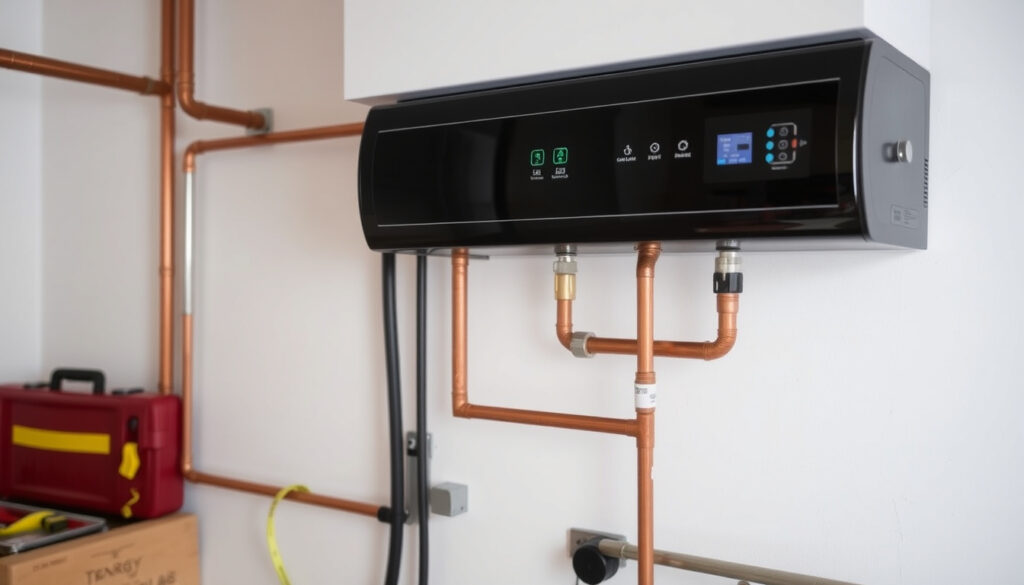
Tankless Water Heater Installation Near Me: Cost & Pros
Anyone who’s endured a cold shower after the last person used all the hot water knows the appeal of a tankless system, but the numbers and options can feel overwhelming. Here’s what the data and local rules actually say.
Average cost (gas): €1,400 – €3,200 ·
Average cost (electric): €750 – €1,400 ·
Lifespan: 20+ years ·
Energy savings: up to 34% (DOE)
Quick snapshot
- Gas tankless installation: €1,400 – €3,200 (24 Hour Plumber Ireland (cost guide))
- Electric tankless installation: €750 – €1,400 (24 Hour Plumber Ireland (cost guide))
- Energy savings up to 34% vs. tank (A. O. Smith (manufacturer cost guide))
- Exact ROI depends on household usage and local fuel prices (24 Hour Plumber Ireland)
- Lifecycle maintenance costs vary by water hardness and brand (IVCG (construction guide))
- No regulatory changes expected in 2025 (SEAI (grant guidance))
- Technology mature; no major innovation curve (SEAI (grant guidance))
- Get at least three quotes from registered installers in your area (24 Hour Plumber Ireland)
- Check SEAI grants for air-to-water heat pumps as an alternative (SEAI (grant page))
Five key facts at a glance, one pattern: the gap between gas and electric installation costs is significant, but operating savings tilt the scale.
| Fact | Value |
|---|---|
| Average cost (gas) | €2,300 (typical) 24 Hour Plumber Ireland |
| Average cost (electric) | €1,100 (typical) 24 Hour Plumber Ireland |
| Annual energy savings | €100 – €200 vs tank A. O. Smith |
| Lifespan | 20+ years Angi (contractor cost guide) |
| Space saved | Up to 60% smaller than a tank |
What is the average cost to install a tankless water heater?
Cost breakdown: gas vs electric tankless installation
- Gas tankless installation: €1,400 – €3,200 (24 Hour Plumber Ireland (cost guide))
- Electric tankless installation: €750 – €1,400 (24 Hour Plumber Ireland)
- Immersion heater replacement: €200 – €500 (24 Hour Plumber Ireland)
- Air-to-water heat pump system: €8,000 – €14,000 (IVCG (construction guide))
Gas units cost more to install but deliver lower running costs over 20 years — electric units are cheaper upfront but cost more per kWh in Ireland at €0.34–€0.40 per kWh Stamford Electrical (Ireland energy guide).
Average installation cost in Ireland (Dublin focus)
- Gas tankless (Dublin): quotes typically €1,800 – €3,000 including VAT at 13.5% on labour
- Electric tankless (Dublin): €800 – €1,300 including VAT
- Under-sink water heater replacement: €300 (part + install, ex. VAT) ImmersionHeater.ie (Dublin supplier)
The implication: Dublin labour rates push the high end of the range, but competition among installers means quotes can vary by 30% for the same unit.
What is the downside of a tankless water heater?
Flow rate limitations for multiple showers
- Standard unit delivers ~7–9 L/min; two showers need ~12–16 L/min (24 Hour Plumber Ireland)
- Cold groundwater in Ireland (≈8°C) reduces output by about 20% compared to warmer climates
- Larger whole-house units can handle 2+ simultaneous showers but cost €1,000+ more
A family of four in Dublin may find that a single tankless unit struggles to keep up with two showers and a dishwasher running at the same time — the unit must be sized carefully, or a second unit added.
Higher upfront cost vs. traditional tank heaters
- Upfront cost is 2–3x higher than a storage tank heater (Angi (contractor cost guide))
- Hot water cylinder replacement: €500 – €1,500 (24 Hour Plumber Ireland)
- Payback period: 5–10 years depending on usage and energy prices
The trade-off: you pay more now to save later, but only if you stay in the home long enough to break even.
Why do plumbers not recommend tankless water heaters?
Common plumber concerns: maintenance and installation complexity
- Hard water scaling in Ireland’s limestone regions requires annual descaling (IVCG (construction guide))
- Gas installations legally require a Registered Gas Installer (RGII) in Ireland
- Electric installations require a Safe Electric registered contractor — DIY is illegal for high-voltage circuits near water (IVCG (Ireland guide))
Why this matters: the complexity of installation and maintenance means many plumbers prefer sticking with traditional tanks that they can service quickly.
When tankless makes sense despite the hesitation
- Homes with high hot water demand (large families, frequent bathing)
- Properties with limited space — no bulky tank needed
- Up to 34% energy savings vs. tank (A. O. Smith (manufacturer data))
If you’re in a hard-water area, budget for annual descaling. Many plumbers will recommend a whole-house water softener to extend the unit’s lifespan.
The pattern: tankless makes sense for space-constrained homes with high demand and a willingness to pay for regular maintenance.
Can I install a tankless water heater myself?
Gas vs electric DIY installation risks
- Gas: Illegal in Ireland without an RGII registered gas fitter — risk of gas leaks, carbon monoxide, and fines (IVCG (Ireland guide))
- Electric: DIY installation of a high-voltage electric shower is illegal in Ireland under I.S. 10101:2020 wiring rules (IVCG (construction guide))
- Self-install void warranties on most major brands (A. O. Smith (manufacturer policy))
DIY tankless installation is a false economy. The cost of correcting a code violation or repairing a water-damaged floor can easily exceed the professional installation fee.
Irish building regulations and required permits
- Gas installations: must comply with I.S. 813, require RGII certification
- Electric installations: must comply with I.S. 10101:2020, include RCD and MCB protection, and be tested and certified (IVCG (construction guide))
- No planning permission needed for a like-for-like unit, but upgrades to gas supply may require notification
Step-by-step professional installation overview
- Site assessment: measure flow rate, gas line capacity, electrical panel amperage
- Unit selection: size based on peak demand (e.g., 10 L/min for a family of four)
- Permits and planning: gas installer verifies compliance; electrician notifies Safe Electric if new circuit
- Installation: mount unit, connect gas/water/electric lines, install pressure relief valve
- Testing and certification: commission unit, test all safety devices, provide certification certificate
The pattern: professional installation takes 4–8 hours and costs €300–€800 in labour, but it comes with a warranty and legal compliance.
Can you run two showers with a tankless water heater?
Flow rate requirements for simultaneous use
- Standard unit: ~7–9 L/min at 40°C rise
- Two showers simultaneously: 12–16 L/min
- Cold groundwater (~8°C in Ireland) reduces output by ~20% (24 Hour Plumber Ireland)
Sizing a unit for multiple bathrooms
- Whole-house gas unit with 150,000 BTU/h can handle 2 showers and a dishwasher
- Electric units typically limited to 1–2 simultaneous outlets due to amperage (e.g., 27 kW unit requires 112A service)
- Larger units cost €1,500–€2,500 more than standard models
A tankless unit that can run two showers in Ireland costs almost as much as a small air-to-water heat pump, which offers better efficiency and can cover heating as well — but the payback is longer.
The implication: if you need two simultaneous showers, expect to invest €1,000+ more for a properly sized unit, and consider alternative systems like air-to-water heat pumps.
Pros and Cons of Tankless Water Heaters
Upsides
- Unlimited hot water on demand
- Up to 34% energy savings vs. tank (A. O. Smith)
- 20+ year lifespan
- Space saving (wall-mounted, no tank)
- Reduced risk of water damage from tank leaks
Downsides
- Higher upfront cost (2–3x tank)
- Flow rate may limit simultaneous use
- Requires professional installation (not DIY)
- Annual descaling needed in hard water areas
- Gas units require RGII registered installer
The decision: tankless wins on efficiency and space, but loses on upfront cost and complexity.
What’s clear and what’s still open
Confirmed facts
- Energy savings up to 34% vs. tank (DOE)
- DIY installation of electric shower is illegal in Ireland
- Gas installations require RGII registration
What’s unclear
- Gas tankless installation cost range: €1,400 – €3,200 (based on limited Irish data)
- Tankless units last 20+ years (longevity depends on maintenance)
- Exact ROI for every home depends on usage patterns and local fuel prices
- Lifecycle maintenance costs vary by water hardness and unit brand
- Payback period ranges from 5 to 10 years
Expert perspectives on tankless installation
Gas installations must be carried out by a Registered Gas Installer. It’s not just a recommendation — it’s the law in Ireland. We see too many DIY attempts that end up with gas leaks or CO risks.
— Registered Gas Installer (RGII), Dublin
Homeowners can avail of grants for heat pump systems under the SEAI scheme, but standard tankless units are not covered. That’s a factor many people miss when comparing costs.
— Sustainable Energy Authority of Ireland (SEAI) guidance
Tankless water heaters can be 24% to 34% more energy efficient than storage tank models, but the savings depend heavily on how much hot water your household uses.
— Consumer Reports / U.S. Department of Energy (DOE) data
For homeowners in Ireland weighing tankless water heater installation, the decision boils down to this: if you need unlimited hot water and have the budget for professional installation and future maintenance, a gas tankless unit is a solid long-term investment. But if you’re tempted by a low upfront cost or a DIY approach, the risks of code violations, voided warranties, and safety hazards make it a false economy. For a family of four in Dublin, the smart move is to get three quotes from registered installers and compare the total cost against your current system before signing off.
Those exploring tankless water heater installation near me should also consult the Navien tankless water heater guide for insights on Navien reliability.
Frequently asked questions
Does a tankless water heater require a special electrical outlet?
Electric tankless units typically require a dedicated circuit with a higher amperage (e.g., 60A to 150A depending on unit size). A standard household outlet is not sufficient. The installation must comply with I.S. 10101:2020 wiring rules and include RCD protection IVCG (construction guide).
How often should I descale a tankless water heater?
In hard water areas (common in Ireland’s limestone regions), manufacturers recommend descaling every 6–12 months. Failure to descale can reduce efficiency and void the warranty.
Can a tankless water heater be installed outside in Ireland?
Yes, many units are rated for outdoor installation, but they must be protected from freezing. In Ireland’s temperate climate, a frost protection kit is usually sufficient. Check the manufacturer’s specifications.
What size tankless water heater do I need for a family of 4?
A family of 4 typically needs a unit that can deliver at least 10 L/min at a 40°C rise. For gas units, look for models with 150,000–200,000 BTU/h. For electric, a 27 kW unit is the minimum for simultaneous use.
Is a tankless water heater more efficient than a heat pump?
Heat pump water heaters (air-to-water) have a higher efficiency (COPs of 3–4) but much higher upfront cost (€8,000–€14,000). Tankless units are more efficient than storage tanks but less efficient than heat pumps. The choice depends on budget and whether you need heating as well.
Do tankless water heaters work with solar panels?
Yes, but they draw high power at once. Solar PV systems can offset the electricity used by an electric tankless unit, but you’ll need a large battery bank or grid export to handle the peak demand. Gas units are unaffected.
How long does tankless water heater installation take?
Professional installation typically takes 4–8 hours for a gas unit (including gas line connection) and 3–6 hours for an electric unit. Complex jobs (e.g., upgrading gas supply or electrical panel) may take longer.
More related posts
 How Great Thou Art – History, Lyrics, Origin and Fame
 As Above So Below Meaning: Origins, Bible & Alchemy
 Everybody Loves Raymond Reunion – Air Dates, Cast and Where to Watch
 Live TV Streaming Services in Ireland 2026 Guide
 Dev Patel’s Monkey Man: Netflix Drop, Injuries, Box Office & More
 Ken Griffey Jr Rookie Card – 2025 Prices and Value Guide
 Be t Pet In urance for Dog in Ireland: Compare Co t & Coverage