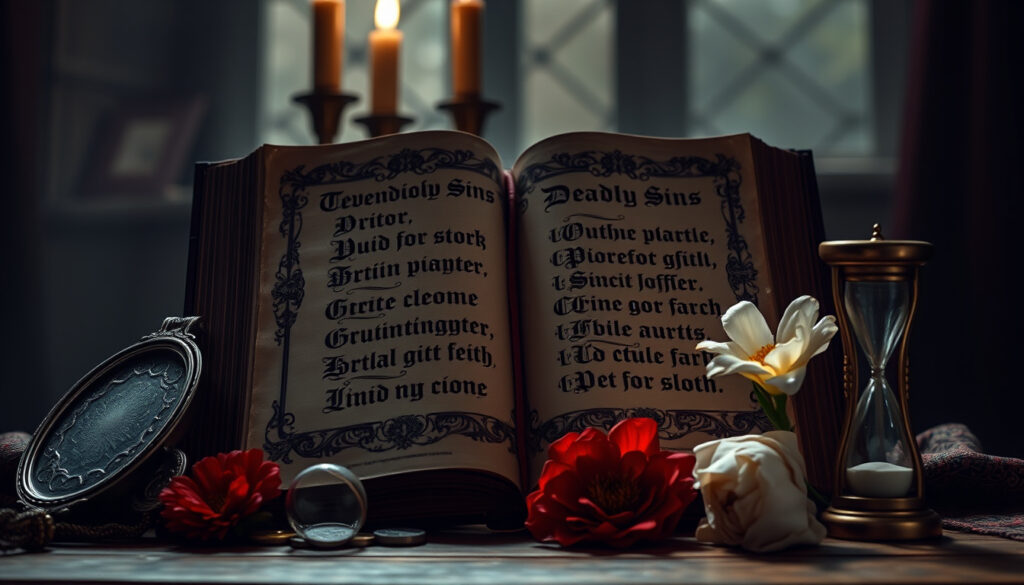
Seven Deadly Sins List, Order, and Meanings
Few moral checklists have traveled as far as the seven deadly sins. They began in the desert monasteries of the 4th century, where the monk Evagrius Ponticus first wrote down eight “evil thoughts,” and have since popped up everywhere—from medieval sermons to modern streaming shows.
Traditional list length: 7 · Earliest known list: 4th century (Evagrius Ponticus) · Common order: Pride, Greed, Lust, Envy, Gluttony, Wrath, Sloth · Unforgivable sin in Christianity: 1 (blasphemy against the Holy Spirit)
Quick snapshot
- The traditional list includes pride, greed, lust, envy, gluttony, wrath, sloth (or acedia) (Britannica (authoritative reference work))
- The concept originated in early Christian monasticism (Britannica)
- Blasphemy against the Holy Spirit is considered unforgivable in Christianity (IslamSeries (interfaith analysis))
- The exact order of the sins varies by source (Catholic Answers (Catholic apologetics resource))
- Whether an eighth sin like acedia is officially recognized (Wikipedia (open encyclopedia))
- The precise interpretation of the unforgivable sin across denominations (Christianity.com (Christian resource))
- 4th century: first list by Evagrius Ponticus (Britannica)
- 6th century: Pope Gregory I standardizes the list of seven (Britannica)
- The list continues to influence art, literature, and modern media (Britannica)
The seven deadly sins are not a fixed biblical list but a flexible framework that gets reinvented by every generation—from medieval preachers using them to diagnose sin to streaming services using them as character archetypes. The stakes: how a culture defines its deadliest vices reveals what it values most.
Five key facts trace the development of the seven deadly sins across different traditions.
| Label | Value |
|---|---|
| Origin | 4th century monk Evagrius Ponticus |
| Pope Gregory I (6th century) | Standardized the list of seven |
| Thomas Aquinas (13th century) | Refined theological meaning |
| Unforgivable sin in Christianity | Blasphemy against the Holy Spirit (Mark 3:29) |
| Unforgivable sin in Islam | Shirk (Quran 4:48) |
What are the seven deadly sins in order?
The traditional list
- Pride – excessive belief in one’s own abilities (Christianity.com (Christian resource))
- Greed – excessive desire for material wealth (Christianity.com)
- Lust – excessive desire for sexual gratification (Christianity.com)
- Envy – jealousy toward others’ success (Christianity.com)
- Gluttony – overindulgence in food or drink (Christianity.com)
- Wrath – intense, uncontrolled anger (Christianity.com)
- Sloth – laziness or avoidance of work (Christianity.com)
This list is the most widely recognized today, but the order you see above is not the only one. The Catholic Church’s Catechism names pride, avarice, envy, wrath, lust, gluttony, and sloth as capital sins (The Thoughtful Catholic (Catholic commentary)). Pope Gregory I arranged them differently: pride, envy, wrath, gluttony, lust, sloth, greed (Britannica).
Historical origins
No single Bible verse lists the seven deadly sins. The tradition emerged from early Christian monasticism, notably the 4th-century monk Evagrius Ponticus, who wrote of eight “evil thoughts” (Britannica). Pope Gregory I condensed them to seven in the 6th century, and Thomas Aquinas later gave them systematic theological treatment (Gospel Mount (Christian theology site)).
Are there 7 or 9 deadly sins?
The 8th deadly sin: acedia or vainglory
Evagrius originally included acedia (spiritual sloth) and vainglory as separate entries. Pope Gregory I folded them into the list we know, but some medieval texts reintroduce an eighth sin (Wikipedia (open encyclopedia)). Acedia is sometimes treated as an expanded form of sloth, while vainglory is linked to pride.
The 9 deadly sins in Eastern Orthodoxy
Eastern Orthodox tradition sometimes enumerates “eight evil thoughts” or “nine deadly passions,” including despondency and vainglory alongside the standard seven (The Thoughtful Catholic). So the count can vary.
The 10 major sins in Christianity (Ten Commandments)
The Ten Commandments (Exodus 20:1-17) are frequently called the 10 major sins, but they are a distinct category from the deadly sins. The seven deadly sins are vices that lead to other sins; the Ten Commandments are direct prohibitions (Simply Catholic (Catholic educational site)).
The pattern: Whether you count 7, 8, or 9 sins, the core idea remains—a shortlist of root vices that spawn other wrongdoing. The variations show how different Christian traditions fine-tune that list.
What sins does God not forgive?
The unforgivable sin: blasphemy against the Holy Spirit
In Christian teaching, the one sin that cannot be forgiven is blasphemy against the Holy Spirit, described in Mark 3:28–29 as an eternal sin (IslamSeries (interfaith comparative analysis)).
Interpretations in Christian theology
Theologians generally view this sin as final unrepentance or deliberately attributing the Holy Spirit’s work to evil, not a casual mistake (Catholic Answers (Catholic apologetics resource)). Many denominations teach that any sin can be forgiven if one repents—except this hardening of the heart against God.
Most Christians believe the unforgivable sin is not a single angry word but a conscious, final rejection of God’s grace. That makes it a rare and extreme case, not a trap for everyday believers.
Which sin is unforgivable in Islam?
Shirk: associating partners with Allah
In Islam, the unforgivable sin is shirk—worshipping anything or anyone alongside Allah. The Quran states, “Allah does not forgive association with Him, but He forgives what is less than that” (Quran 4:48) (IslamSeries (Islamic theological analysis)).
Repentance and forgiveness in Islam
Unlike Christianity’s single unforgivable sin, Islam limits the unforgivable status to shirk if one dies without repenting. All other sins—including the “seven great destructive sins” listed in hadith—can be forgiven by Allah’s mercy (IslamSeries).
What this means: The two major Abrahamic faiths both identify a single unforgivable sin, but they define it differently—one as blasphemy against the Holy Spirit, the other as associating partners with God.
Who is LGBTQ in seven deadly sins?
LGBTQ+ representation in the anime “The Seven Deadly Sins”
The anime series The Seven Deadly Sins (based on the manga by Nakaba Suzuki) does not feature confirmed LGBTQ+ characters. Its main characters are depicted as predominantly heterosexual, and no character explicitly identifies as LGBTQ+.
The Seven Deadly Sins in Helluva Boss
In contrast, the web series Helluva Boss by Vivienne Medrano includes characters based on the seven deadly sins who are part of the LGBTQ+ spectrum. Notable examples include Stolas (a demon prince based on the sin of pride) and Blitzo (an imp assassin), whose relationship is a central storyline and is explicitly queer (Wikipedia (open encyclopedia) – cultural adaptations section).
Why this matters: The flexibility of the seven deadly sins as archetypes allows creators to repurpose them for diverse storytelling, including LGBTQ+ narratives that weren’t part of the original religious framework.
Comparing the lists: Christian vs. Islamic unforgivable sins
Three key differences emerge when you set the Christian and Islamic classifications side by side.
| Aspect | Christianity | Islam |
|---|---|---|
| Unforgivable sin | Blasphemy against the Holy Spirit | Shirk (associating partners with Allah) |
| Scriptural basis | Mark 3:28-29 | Quran 4:48 |
| Nature of the sin | Final unrepentance / attributing Holy Spirit’s work to evil | Worship of anything besides Allah |
| Forgiveness for other sins | All sins forgivable if repented | All sins forgivable if repented, except shirk at death |
| Relation to seven deadly sins | Separate category; the deadly sins are capital vices | Islam has its own list of great destructive sins (e.g., hadith) |
The trade-off: Both faiths reserve ultimate unforgiveness for a sin that challenges God’s uniqueness, but Christianity emphasizes a hardened heart while Islam emphasizes theological exclusivity.
Confirmed facts
- The traditional list of seven deadly sins includes pride, greed, lust, envy, gluttony, wrath, sloth.
- The concept originated in early Christian monasticism.
- Blasphemy against the Holy Spirit is considered unforgivable in Christianity.
What’s unclear
- The exact order of the sins varies by source.
- Whether an eighth sin like acedia is officially recognized.
- The precise interpretation of the unforgivable sin across denominations.
The seven deadly sins are not presented as a single biblical list in the Bible, but as a later Christian tradition.
In Roman Catholic theology, the seven deadly sins are typically ordered as pride, greed, lust, envy, gluttony, wrath, and sloth.
Britannica (authoritative reference work)
Islam considers shirk, associating partners with God, as the unforgivable sin if unrepented at death.
IslamSeries (Islamic theological analysis)
The seven deadly sins have proved remarkably resilient—shifting from a monastic tool for spiritual diagnosis to a flexible cultural template that appears in everything from Dante’s Inferno to Netflix series. Each generation redefines “deadly” behavior to match its own anxieties and values, and that process shows no sign of stopping.
Related reading: A Brief History of the Seven Deadly Sins · Understanding the 7 Deadly Sins
wbbw.org, encyclopedia.com, simple.wikipedia.org, bibleinfo.com
Frequently asked questions
What is the origin of the seven deadly sins?
The concept originated in 4th-century Christian monasticism with Evagrius Ponticus, who listed eight evil thoughts. Pope Gregory I reduced them to seven in the 6th century, and Thomas Aquinas elaborated on them in the 13th century (Britannica).
How do the seven deadly sins differ from the Ten Commandments?
The Ten Commandments are direct prohibitions from the Bible, while the seven deadly sins are a classification of vices that lead to other sins. They are separate lists serving different purposes (Simply Catholic).
What is gluttony?
Gluttony is the overindulgence or overconsumption of food and drink, considered a capital sin because it can lead to other vices (Christianity.com).
Is sloth the same as laziness?
Sloth (acedia) includes laziness but also spiritual apathy—a lack of enthusiasm for doing good or fulfilling one’s duties (The Thoughtful Catholic).
What is the difference between the seven deadly sins and the seven virtues?
The seven heavenly virtues (chastity, temperance, charity, diligence, patience, kindness, humility) are opposing counterparts to the seven deadly sins. Each virtue is meant to combat a corresponding vice.
Are the seven deadly sins mentioned in the Bible?
No single biblical verse lists all seven sins together. The list is a later Christian tradition, though each sin individually appears in Scripture (Gospel Mount).
What is vainglory?
Vainglory is excessive pride or boastfulness about one’s own achievements. It was originally part of Evagrius’ eight evil thoughts and later merged with pride in the standard list (Wikipedia).
More related posts
 Weight Loss Calculator by Date: Goal Timeline Predictor
 Everybody Loves Raymond Reunion – Air Dates, Cast and Where to Watch
 Pikes Peak Cog Railway: Cost, Ride Time & Best Seats Guide
 What Is BCC in Email – Meaning, CC Comparison and Best Uses
 4 Quarts to Cups: How Many Cups in 4 Quarts? (Conversion Guide)
 Maya Rudolph Movies and TV Shows: Complete List & Guide
 Wright-Patt Credit Union: Phone, Hours & Locations
 The Ballad of Buster Scruggs: Endings, Cast, Review & Guide