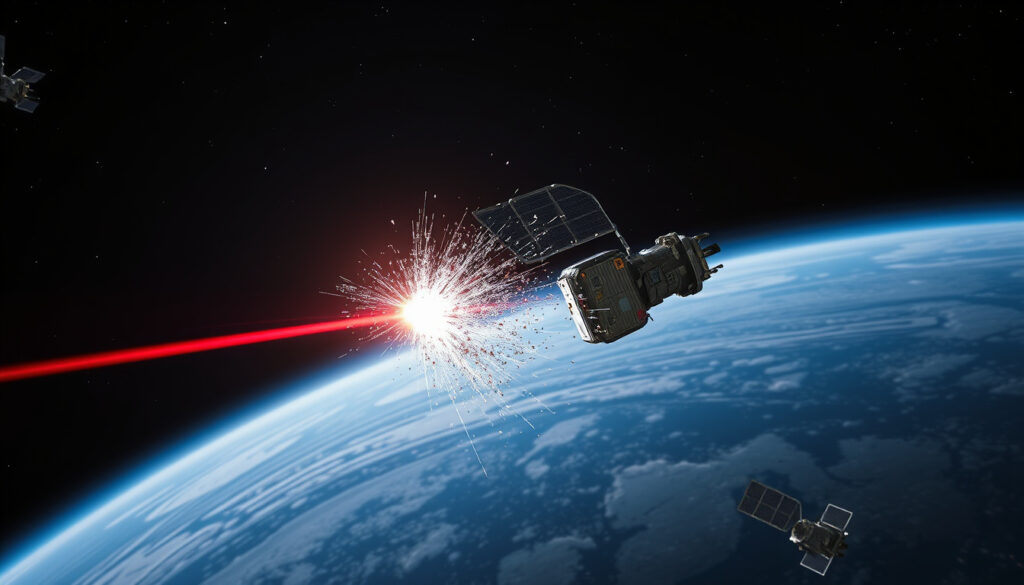
Chinese Satellite Pulverizes Starlink With 2-Watt Laser
When news broke that a Chinese satellite had “pulverized” Starlink with a 2‑watt laser, it sounded like a David‑and‑Goliath story for the space age. But the reality is more nuanced: researchers demonstrated a 1 Gbps optical link from geostationary orbit using surprisingly little power—a breakthrough for power‑efficient long‑distance communications, not a direct replacement for low‑Earth‑orbit broadband. Here is what the test actually achieved, and why Starlink is not trembling just yet.
Chinese laser data rate: 1 Gbps (claimed) ·
Starlink typical speed: up to 200 Mbps ·
Orbit altitude: 36,000 km (geostationary)
Quick snapshot
- Chinese satellite transmitted data at 1 Gbps via 2‑watt laser from 36,000 km orbit (SCMP (leading Hong Kong news outlet))
- Test was reported by multiple sources (SCMP, Space4Peace)
- Starlink is owned by Elon Musk and not available in China (Wikipedia (encyclopedic reference))
- Whether the system can operate reliably outside experimental conditions (Futura‑Sciences (science & tech news))
- Actual real‑world speeds compared to Starlink under varying weather (Broadband Breakfast (industry analysis))
- Commercial viability and deployment timeline (Space4Peace)
- May 2019 – First Starlink satellites launched (Wikipedia)
- June 2025 – Chinese satellite achieves 5× Starlink speed with 2‑watt laser (SCMP)
- July 2025 – Space4Peace reports on the test (Space4Peace)
- Watch for operational deployment announcements from China (Interesting Engineering (tech innovation coverage))
- Geopolitical pressure on satellite spectrum allocation (Broadband Breakfast)
Here are the key attributes of the test:
| Attribute | Value |
|---|---|
| Satellite orbit | Geostationary (36,000 km) |
| Laser power | 2 Watts |
| Achieved speed | 1 Gbps |
| Starlink typical speed | 50–200 Mbps |
| Test date | June 2025 |
| Starlink owner | Elon Musk (SpaceX) |
| Starlink availability in China | Not available |
How many Starlink satellites have fallen?
Starlink operates thousands of satellites in low Earth orbit (LEO), and some inevitably re‑enter the atmosphere. According to Wikipedia (spaceflight encyclopedia), the decay rate has dropped from roughly 500 per year early on to about 200 per year as the fleet matures. Each re‑entry poses a small debris risk, but SpaceX designs satellites to burn up completely on re‑entry.
The implication: while falling satellites grab headlines, the risk of ground impact remains very low. What matters is how quickly the constellation expands—SpaceX now launches about 40–50 new satellites per week.
Are Chinese satellites better than Starlink?
That depends on the job you need done. Seven key differences:
| Metric | Chinese laser test | Starlink (typical) |
|---|---|---|
| Orbit altitude | 36,000 km (GEO) | ~340–550 km (LEO) |
| Data rate per link | 1 Gbps | 50–200 Mbps |
| Latency (round trip) | ~500 ms | 20–40 ms |
| Power per link | 2 W (laser) | ~50–100 W (RF) |
| Coverage per satellite | ~1/3 of Earth | ~1,000 km spot |
| Service status | Experimental only | Active in 100+ countries |
| Commercial pricing | Not announced | $120 /month (U.S.) |
The catch: GEO’s extreme latency makes the Chinese laser unsuitable for real‑time apps like video calls or gaming. Starlink’s LEO advantage in latency is decisive for most consumer internet use. As Broadband Breakfast (industry analysis) points out, the two systems solve very different problems—one is a proof‑of‑concept for efficient deep‑space links, the other a mass‑market broadband constellation.
Specs of the Chinese laser system are still spotty, but here is what the research describes:
| Parameter | Value (reported) |
|---|---|
| Laser power | 2 Watt |
| Wavelength | Not disclosed |
| Modulation | AO‑MDR (adaptive optics + mode‑diversity reception) |
| Signal improvement | Usable signals rose from ~72% to >91% |
| Multi‑plane converter | Used to select strongest signal path |
| Lead researchers | Wu Jian and Liu Chao |
| Orbit | Geostationary (36,000 km) |
| Link type | Downlink to Earth station |
For China, the test proves that a tiny laser can punch through the atmosphere from GEO—opening the door to lighter, cheaper satellites. But consumers stuck with 40 ms Starlink latency have no reason to switch.
What billionaire owns Starlink?
Starlink is a project of SpaceX, founded and run by Elon Musk. According to Wikipedia (biographical reference), Musk is the CEO and Chief Engineer of SpaceX, and holds a majority stake. Starlink is a wholly owned subsidiary of SpaceX, though Musk has hinted at a future spin‑off IPO.
The trade‑off: Starlink’s fortunes rise and fall with one man’s decisions—and his attention is split across Tesla, X, xAI, and The Boring Company. A single‑owner structure can move fast, but it also concentrates risk.
Musk’s control means Starlink’s expansion into new regions often hinges on his political alignments. China’s ban on Starlink is partly because it cannot guarantee access or oversight under a single billionaire’s rule.
Why is Starlink not working in China?
China bans foreign satellite internet services like Starlink for both regulatory and national security reasons. The Chinese regulatory framework requires all telecommunications services to be operated by state‑licensed domestic providers. Starlink terminals cannot obtain the necessary approvals, and the government actively blocks unauthorized satellite terminals.
What this means: for Chinese users, the only legal satellite internet will come from Chinese state‑backed constellations—like the one that just demonstrated the laser link. Starlink remains unavailable even as a backup.
Can you bring a Starlink mini for backup in China?
Technically, the portable Starlink Mini dish exists, but using it inside China violates telecommunications laws. According to Reuters (global news agency), Chinese customs may confiscate unauthorized satellite equipment, and penalties can include fines or more severe sanctions. Even for temporary travel, the risk is significant.
The pattern: China’s regulatory walls are designed to protect its domestic satellite industry. Bringing a Starlink mini is akin to smuggling a banned radio device—possible but inadvisable. For travelers needing backup connectivity, local SIM cards or hotel Wi‑Fi remain the only legal options.
Timeline: Key events
- May 2019 – First Starlink satellites launched (Wikipedia)
- June 2025 – Chinese satellite achieves 5× Starlink speed with 2‑watt laser (SCMP)
- July 2025 – Space4Peace reports on the test (Space4Peace)
- April 2026 – Indian Defence Review adds further analysis (Indian Defence Review)
The timeline signal: from first test to follow‑up analysis within a year suggests active development. But no commercial service is announced yet.
What we know and what remains unclear
Confirmed facts
- 1 Gbps downlink achieved from GEO with 2‑watt laser (SCMP)
- Project led by Wu Jian and Liu Chao (SCMP)
- Technique called AO‑MDR (adaptive optics + mode‑diversity reception) (Broadband Breakfast)
- Usable signals improved from ~72% to >91% (Futura‑Sciences)
- Starlink not available in China (Wikipedia)
What’s unclear
- Operational reliability beyond experimental conditions
- Real‑world speeds under weather or interference
- Commercial deployment timeline and pricing
- Wavelength and exact modulation details
- Whether the laser link can work both uplink and downlink
The balance of known facts and unknowns suggests the technology is promising but far from market-ready.
Expert perspectives
“The researchers called the method ‘groundbreaking’ and said it achieved five times Starlink speed.”
— Chinese researchers, reported by SCMP
“The test is an impressive leap in satellite communication, but it does not eliminate the fundamental latency disadvantage of GEO.”
— Analysis from Space4Peace
For international internet users and investors, the choice is clear: China’s 2‑watt laser is a brilliant engineering feat for deep‑space links, not a consumer broadband threat. Starlink’s LEO constellation remains the only viable low‑latency option for most of the world—but for Chinese citizens, the only legal satellite internet will come from Beijing’s own programs. Expect geopolitical friction over spectrum allocation and space traffic management in the coming years.
For a balanced perspective, a detailed analysis of what actually occurred offers a thorough fact-check of the event.
Frequently asked questions
What is a 2‑watt laser satellite?
A satellite that uses a laser with only 2 watts of power to transmit data to Earth from geostationary orbit. Chinese researchers demonstrated a downlink at 1 Gbps using this method.
How does the Chinese laser satellite compare to Starlink?
The Chinese satellite achieved higher raw speed (1 Gbps vs. Starlink’s typical 50–200 Mbps) but suffers from ~500 ms latency due to its geostationary orbit. Starlink’s LEO orbit gives it 20–40 ms latency, better for real‑time use.
Is Chinese satellite internet available to consumers?
No, the test was an experimental demonstration. No commercial service has been announced.
What are the technical challenges of the laser link?
Maintaining a stable laser signal through atmospheric turbulence is hard. The researchers used adaptive optics and mode‑diversity reception to boost usable signals from ~72% to >91%.
Who conducted the test?
The project was led by Chinese researchers Wu Jian and Liu Chao, reported by SCMP.
How does geostationary orbit benefit internet speed?
GEO allows one satellite to cover a huge area (about one‑third of Earth), but the 36,000 km distance introduces unavoidable latency.
Will China’s satellite internet compete globally?
Potentially for markets where low latency is not critical (e.g., bulk data transfer, broadcasting). But for consumer broadband, Starlink’s low‑latency LEO network has a major edge.
More related posts
 Dev Patel’s Monkey Man: Netflix Drop, Injuries, Box Office & More
 Great Wolf Lodge Locations: Complete Guide to 23 Resorts
 The Diplomat Season 4: Netflix Release Date, Cast & News
 How Great Thou Art – History, Lyrics, Origin and Fame
 Is Edge of Eternities Worth It? MTG Set Value & Top Cards (2025)
 How Long Is a Football Field? Soccer vs American Football
 Golden State Warriors Players: Roster, Salaries, and All-Time Greats
 Jake Paul vs Anthony Joshua Date: Fight Time & Results