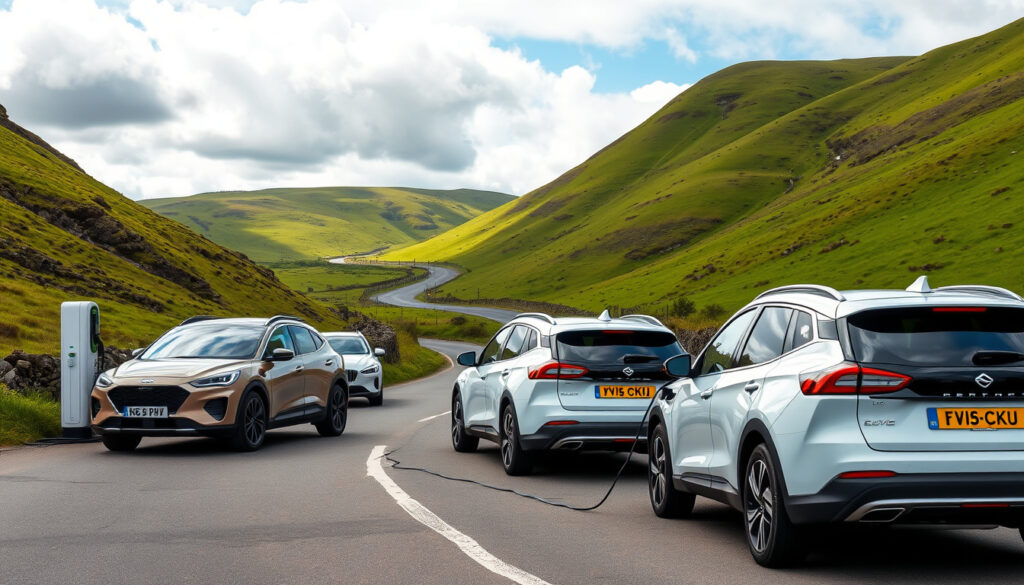
Best Plug-in Hybrid SUVs: Top Picks for UK and Ireland
If you’ve been weighing up a plug-in hybrid SUV for family trips around Ireland or the UK, the 2035 ban debate has probably made that decision trickier. New figures show PHEVs still held 11.7% of UK new car registrations in April 2025, yet grant incentives have quietly vanished. This guide cuts through the noise — comparing the best plug-in hybrid SUVs, explaining how they stack up against standard hybrids, and giving you a clear read on whether buying one now makes financial sense for Irish and British drivers.
Top PHEV SUV (Carwow): BMW X5 · Used PHEV SUVs in Ireland: 16,811 available · Best value hybrid SUV (Car Magazine): Dacia Jogger · 10 best PHEV SUVs listed (Carwow): Chery Tiggo 8 to Hyundai Santa Fe
Quick snapshot
- BMW X5 ranks at the top of expert PHEV lists (Carwow)
- Ireland aims to end new ICE sales by 2030 (IrishEVs)
- EU softening 2035 ban to allow hybrids on market (The Irish Times)
- Whether EU will confirm post-2035 PHEV flexibilities
- Long-term resale value of PHEVs amid changing regulations
- €2,500 PHEV grant removed in Ireland from 1 January 2022
- UK PHEVs hit 11.7% of registrations in April 2025
- EU examining PHEV rules after 2035 (February 2025)
- Ireland ICE ban deadline looms at end of 2030
- UK/EU new sales ban set for end of 2035
- Used PHEV market likely to remain active post-ban
This table summarises the key data points referenced throughout the guide.
| Metric | Value |
|---|---|
| Top PHEV SUV (UK) | BMW X5 (WhatCar) |
| Used PHEV SUVs (Ireland) | 16,811 (CarsIreland) |
| Best value hybrid SUV | Dacia Jogger (Car Magazine) |
| PHEV SUVs listed (Carwow) | 10 models |
| UK PHEV market share (April 2025) | 11.7% |
| Ireland PHEV grant removed | 1 January 2022 |
What is the best plug-in hybrid SUV?
The BMW X5 xDrive45e appears at the summit of most expert rankings for plug-in hybrid SUVs, matching few competitors on comprehensive PHEV capability according to WhatCar. Hyundai’s Santa Fe earns a 9/10 rating from Carwow, making it a standout for families wanting space without sacrificing efficiency.
Top-rated models from experts
- BMW X5 — Top-rated PHEV SUV with premium efficiency (WhatCar)
- Hyundai Santa Fe — 9/10 family SUV PHEV (Carwow)
- Porsche Cayenne — Best to drive among luxury hybrids (Car Magazine)
- Mercedes C 300 e — Ranked best PHEV in Ireland for luxury and eco-conscious driving (InsureMyCars.ie)
- Lexus NX 450h+ — Luxury PHEV SUV with powerful hybrid system (InsureMyCars.ie)
Premium brands dominate the top PHEV SUV rankings, but mainstream options like the Hyundai Santa Fe deliver nearly identical efficiency scores at a lower price point. For Irish buyers watching budgets, that gap matters more than badge prestige.
BMW X5 and Hyundai Santa Fe highlights
The BMW X5 xDrive45e combines a 3.0-litre turbocharged inline-six engine with an electric motor, delivering impressive performance and a usable electric range. The Santa Fe PHEV offers seven seats and a practical interior, making it ideal for larger families in Ireland.
“Very few SUVs match the BMW X5’s comprehensive PHEV capability,” according to WhatCar experts.
What are the top 5 plug-in hybrid SUVs?
The Carwow list of 10 best PHEV SUVs spans from premium to affordable options. The rankings include the Chery Tiggo 8, BMW X5, and Hyundai Santa Fe, with the Porsche Cayenne noted as the best to drive by Car Magazine.
For Irish buyers specifically, InsureMyCars.ie highlights the Kia Sportage PHEV for its versatile powertrain and family-friendly interior. The Renault Captur E-Tech also appears on Irish market recommendations.
This comparison table breaks down the leading models by key attributes.
| Model | Body Style | Key Strength | Source |
|---|---|---|---|
| BMW X5 | Large SUV | Top PHEV capability | WhatCar |
| Hyundai Santa Fe | Large SUV | 9/10 family rating | Carwow |
| Porsche Cayenne | Large SUV | Best driving dynamics | Car Magazine |
| Mercedes C 300 e | Sedan | Best Irish PHEV | InsureMyCars.ie |
| Kia Sportage PHEV | Compact SUV | Versatile family option | InsureMyCars.ie |
“Big cars with bigger efficiency define the 10 best plug-in hybrid SUVs,” notes Carwow’s automotive editorial team.
The pattern shows luxury brands leading on performance ratings, while mainstream manufacturers catch up on practicality and value. Irish buyers prioritising budget should look at the Dacia Jogger Hybrid, which Car Magazine names best value hybrid SUV for families.
What is better, a hybrid or plug-in hybrid SUV?
The choice between a standard hybrid (HEV) and a plug-in hybrid (PHEV) depends on driving patterns and charging availability. According to LM Operations, PHEVs are more efficient when regularly charged, but self-charging hybrids work better for mixed driving without plug access.
Key differences in powertrains
- Self-Charging Hybrid (HEV) — No plug required; battery charges through regenerative braking; better for drivers who can’t charge daily
- Plug-In Hybrid (PHEV) — Larger battery with external charging; higher upfront cost but significantly better efficiency for short trips
- Full Electric (EV) — Zero tailpipe emissions; limited range but no fuel costs for daily commutes
The Toyota Corolla Hybrid achieves over 50 mpg according to LM Operations, making it a strong everyday choice for Irish drivers who don’t want to manage charging logistics.
The implication: if you regularly drive under 30 kilometres daily and have home charging, a PHEV saves more fuel. For longer rural commutes without charging infrastructure, an HEV makes more practical sense.
What is the downside of a plug-in hybrid?
Plug-in hybrids face growing scrutiny as bans approach. StartRescue.co.uk notes that PHEVs have higher real-world emissions than official figures suggest, especially when not regularly charged. The 2035 ban adds uncertainty to long-term resale values.
Common PHEV drawbacks
- Higher upfront cost — PHEVs cost more than equivalent HEVs or ICE vehicles
- Charging requirement — Benefits only materialize with regular charging; otherwise efficiency approaches standard hybrids
- Complex maintenance — Two powertrains mean potentially higher repair costs
- Uncertain resale — Post-2035 ban demand for used PHEVs remains unclear
No SEAI grant applies to PHEVs in Ireland, though reduced BIK tax still benefits company car drivers (LM Operations).
The catch: PHEVs make most sense for drivers who can exploit the electric range daily while accepting that regulatory changes may affect vehicle values before the end of typical ownership periods.
Is it still worth buying a PHEV?
For Irish and UK buyers, the answer depends on timeline and usage. The used PHEV market in Ireland shows 16,811 available SUVs according to CarsIreland data, indicating healthy supply for second-hand buyers. However, IrishEVs advocates including all hybrids in Ireland’s 2030 ICE ban, which would end new PHEV sales earlier than the UK and EU’s 2035 timeline.
Ireland and Europe options
Irish buyers face a tighter window than UK customers. Ireland’s ban on new ICE sales targets end of 2030, while the UK and EU plan 2035 for new petrol, diesel, and hybrid vehicle sales. The EU has softened its 2035 stance, The Irish Times reports, allowing hybrids to potentially stay on sale longer.
For families prioritising value, the Dacia Jogger Hybrid offers an affordable entry point with good practicality for larger Irish households, per LM Operations. Used PHEV buyers can still access models like the Kia Niro Hybrid and Hyundai Kona Hybrid at lower prices than new.
Buying a PHEV in 2025 or 2026 remains viable for drivers who can charge daily and plan to run the vehicle through the ban period. Irish buyers should act sooner given the 2030 deadline, while UK buyers have more flexibility through 2035.
Upsides
- Lower fuel costs for daily commutes under 40km
- Used market offers good value with 16,811+ PHEV SUVs in Ireland
- Reduced BIK tax for Irish company car drivers
- Blends urban EV trips with longer combustion journeys
- Existing PHEVs remain road-legal after 2035
Downsides
- No SEAI grant available for PHEVs in Ireland
- Higher real-world emissions when not regularly charged
- Irish 2030 ICE ban may include hybrids
- Uncertain long-term resale values
- Premium pricing versus standard hybrids
Related reading: best plug-in hybrid SUVs · best plug-in-hybrid compact SUVs
Among evolving family SUVs, the Toyota RAV4 2026 PHEV specs deliver hybrid powertrains starting at €46,795, ideal for Irish drivers facing the 2035 ban.
Frequently Asked Questions
What is a plug-in hybrid SUV?
A plug-in hybrid SUV combines a traditional internal combustion engine with a larger battery that can be charged via an external power source. This gives drivers electric-only range for short trips alongside fuel-based range for longer journeys.
How does PHEV range work?
PHEVs typically offer 30-60 kilometres of electric-only range, according to StartRescue.co.uk. Once depleted, the combustion engine takes over, giving unlimited total range.
What is the best small plug-in hybrid SUV?
The Kia Sportage PHEV and Hyundai Kona Hybrid rank among the best small PHEV SUVs available in Ireland. InsureMyCars.ie recommends both for urban and family use.
Are PHEVs good for short trips?
Yes. LM Operations confirms PHEVs excel for short trips when regularly charged, delivering fuel savings that standard hybrids cannot match.
Why consider used plug-in hybrid SUVs?
With 16,811 used PHEV SUVs available in Ireland according to CarsIreland, buyers can access premium models like the BMW X5 and Mercedes C 300 e at significant discounts. Existing vehicles remain road-legal after any future bans.
Irish buyers seeking a PHEV SUV should prioritise models with strong electric range and act before 2030 when Ireland’s ICE ban takes effect. UK buyers have more time under the 2035 deadline but face similar regulatory uncertainty around hybrid inclusion.
More related posts
 In the Heart of the Sea: True Story, Box Office Flop & Cast Facts
 DIY Fruit Fly Trap: 4 Tested Homemade Methods That Actually Work
 Ohio State vs Indiana: Score, Recap, and How to Watch
 Oreimo: Plot, Ending & Controversy Explained
 Card Shows Near Me: 2025-2026 Ireland Events Guide
 How Many Stamps Do I Need – 2025 USPS Postage Guide
 What Is BCC in Email – Meaning, CC Comparison and Best Uses