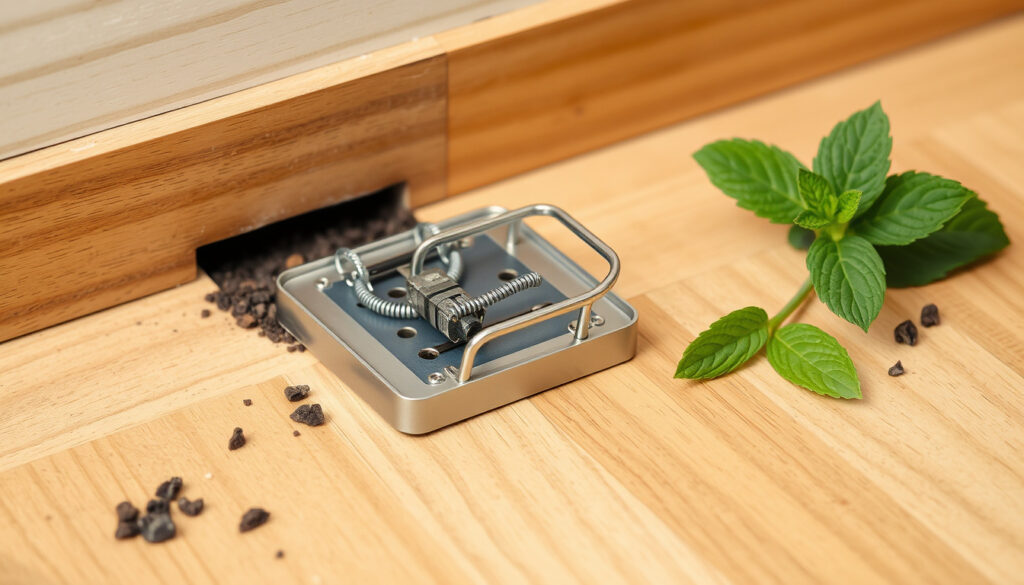
How to Get Rid of Mice Fast: Traps, Scents & Exclusion Tips
Anyone who’s heard the scuttling in the walls knows the feeling — mice are unwelcome guests that settle in fast. They can squeeze through gaps as small as 1/4 inch (6-7 mm), and a single mouse can produce up to 50 droppings a night. This guide brings together expert-validated methods from Irish pest control specialists and editorial sources to help you get rid of mice fast and keep them out for good.
Smallest entry gap: 1/4 inch (6-7 mm) ·
Daily droppings per mouse: 40-50 ·
Litter size: 6-8 young ·
Reproduction cycle: Every 3 weeks
Quick snapshot
- Snap traps with peanut butter (Healthline (health information publisher))
- Glue boards (controversial, not recommended) (Healthline (health information publisher))
- Immediate hole sealing with steel wool and caulk (Healthline (health information publisher))
- Peppermint oil (temporary, needs reapplication every 2-3 days)
- Vinegar and ammonia (limited evidence)
- Cotton ball method soaked in oil or vinegar
- Steel wool mixed with caulk (Irish Independent (Ireland’s leading news outlet))
- Wire mesh and cement for larger gaps (Irish Independent (Ireland’s leading news outlet))
- Duct tape as temporary patch (Irish Independent (Ireland’s leading news outlet))
- Large infestation signs (multiple droppings, nests)
- Recurring after DIY efforts
- Health risk from droppings — HSE recommends PPE
Five key numbers, one pattern: mice reproduce fast and fit through tiny spaces — making early detection critical.
| Fact | Value |
|---|---|
| Smallest entry gap | 1/4 inch (6-7 mm) |
| Daily droppings per mouse | 40-50 |
| Litter size | 6-8 young |
| Reproduction cycle | Every 3 weeks |
| Common species in homes | House mouse (Mus musculus) |
How do you get rid of mice fast?
Immediate trap placement
- Snap traps loaded with peanut butter are the fastest mechanical method (Healthline (health information publisher)).
- Place traps along walls with the baited end against the baseboard — mice follow edges and are more likely to trigger them (Healthline (health information publisher)).
- Check traps daily and release captured mice at least 1 mile away if using humane traps (Healthline (health information publisher)).
Snap traps are preferred over glue boards, which cause prolonged suffering and are widely condemned by pest professionals (Pat Sullivan (pest control professional on YouTube)).
Snap traps remain the gold standard for speed, but misplacement reduces effectiveness. Always position traps perpendicular to walls, bait side facing the wall.
Sealing entry points
- Steel wool mixed with caulk is the preferred method for Irish homes (Irish Independent (Ireland’s leading news outlet)).
- Wire mesh and cement block larger holes (Pest Control Ireland (Irish pest control specialists)).
- Duct tape can temporarily seal small openings (Healthline (health information publisher)).
Mice can squeeze through gaps as small as 1/4 inch (6-7 mm) — check around pipes, under sinks, and behind cupboards (Pest Control Ireland (Irish pest control specialists)). Professional exclusion follows a three-step process: forensic inspection, fortification, and trapping (Attic Bros (pest control blog)).
Removing food sources
- Store pet food in sealed containers and clean crumbs immediately.
- Take out garbage daily and secure compost bins.
- Remove bird feeders and fallen fruit from gardens.
According to Citizens Information Ireland (official state information), removing food sources is a key prevention step.
The implication: snap traps plus exclusion give the fastest results, but without removing food, mice will keep coming back.
What smells do mice hate?
Peppermint oil
- Peppermint oil is widely mentioned as a mouse deterrent, though its effectiveness is not scientifically proven (Healthline (health information publisher)).
- Scent typically lasts 2-3 days before reapplication is needed (RTE Ireland (national broadcaster)).
Soak cotton balls in pure peppermint oil and place them near entry points, but replace them frequently as the odor dissipates.
Natural scents may offer temporary relief, but they require constant reapplication and won’t solve an established infestation. Physical exclusion is the only lasting solution.
Hot pepper solution
- A spray made from hot peppers can act as a non-poisonous repellent safe around pets and children (Healthline (health information publisher)).
Apply under stoves and behind appliances. Like other natural repellents, its effect is temporary.
Using cotton balls
Soaking cotton balls in strong essential oils or vinegar and placing them in infested areas is a common home remedy. While anecdotal reports are mixed, the low cost makes it worth trying alongside other methods. No scent guarantees long-term elimination.
What this means: while smells can provide short-term discouragement, they should be viewed as a supplement to physical exclusion, not a substitute.
Does 2 mice mean an infestation?
Signs of active mice
- Look for droppings (40-50 per mouse per night), gnaw marks, and tracks along baseboards (HSE Ireland (national health service)).
- Hantavirus risk from droppings requires wearing gloves and a mask during cleanup, per HSE Ireland (national health service).
Reproduction rate and colony size
Mice breed every three weeks, producing litters of 6-8 young. A single pair can lead to dozens within months. According to Citizens Information Ireland (official state information), infestations peak in autumn and winter when cold weather drives rodents indoors.
When to call a professional
- If you see multiple mice, droppings in several rooms, or hear scratching in walls, it’s time to call a licensed pest controller.
- Rodenticide use in Ireland requires professional certification under the Pest Control Regulations 2017 (HSE Ireland (national health service)).
The pattern: two mice are rarely alone — the combination of rapid reproduction and hidden activity means prompt action is essential.
When you catch one mouse, are there more?
Evidence that one mouse means more
- Mice are nocturnal and secretive; a single mouse seen during the day often indicates a larger population.
- A single trap might catch only one, while others remain hidden (Healthline (health information publisher)).
How to check for other mice
- Inspect for droppings, nests, and gnaw marks in attics, basements, and behind appliances.
- Use a torch to look for grease marks along walls — mice leave oily trails.
Trap placement strategies
- Place multiple traps spaced 2-3 feet apart along walls. Using two traps side by side increases catch rate.
- Bait with peanut butter, cheese, or buttered popcorn (Healthline (health information publisher)).
Why this matters: if you caught one mouse, assume there are more. Continuous trapping over several days is the only way to gauge the extent of the infestation.
How do tea bags get rid of mice?
The myth of tea bag repellents
- No credible evidence supports the claim that tea bags repel mice (RTE Ireland (national broadcaster)).
- Mice are not attracted or repelled by tea — the internet myth likely arose from the strong scent of certain teas being confused with essential oils.
What actually works
- Use traps and exclusion methods instead of folk remedies.
- Steel wool, caulk, and snap traps are proven solutions (Irish Independent (Ireland’s leading news outlet)).
Professional advice from Bugwise
Professional pest controllers consistently advise against relying on household items like tea bags. “Mice are driven by food and shelter — strong odors won’t keep them out if they can squeeze through a hole,” says a Rentokil Ireland pest expert.
The takeaway: tea bags are a harmless but ineffective myth. Spend your effort on sealing cracks and placing traps.
Step-by-Step Guide
Follow these steps in order to eliminate mice and prevent their return.
- Inspect your home for entry points, droppings, and signs of nesting. Use a flashlight to check behind appliances and in attics (HSE Ireland (national health service)).
- Seal all gaps larger than 1/4 inch with steel wool mixed with caulk (Irish Independent (Ireland’s leading news outlet)). For larger holes, use wire mesh and cement (Pest Control Ireland (Irish pest control specialists)).
- Set traps along walls, using peanut butter as bait. Use multiple snap traps for best results (Healthline (health information publisher)).
- Remove food sources: store pet food in sealed containers, clean up crumbs, and secure garbage (Citizens Information Ireland (official state information)).
- Clean and disinfect infested areas using gloves and a mask, following HSE guidelines for hantavirus prevention (HSE Ireland (national health service)).
- Monitor and repeat trapping until no new mice are caught for a week.
The key: exclusion before trapping. Sealing holes first prevents new mice from entering while you eliminate the ones inside.
Confirmed facts & what remains unclear
Confirmed facts
- Snap traps are effective when baited with peanut butter (Healthline (health information publisher)).
- Steel wool mixed with caulk blocks rodent entry (Irish Independent (Ireland’s leading news outlet)).
- Peppermint oil is a popular but temporary deterrent (RTE Ireland (national broadcaster)).
- Tea bags do not repel mice.
- Ultrasonic repellents show low efficacy (The Journal IE (Irish news website)).
What’s unclear
- How long scent-based deterrents remain effective without reapplication.
- Whether mice truly avoid sleeping humans — no controlled studies exist.
- Effectiveness of ultrasonic devices remains unproven in peer-reviewed research (The Journal IE (Irish news website)).
Expert perspectives
“Using durable materials like cement and wire mesh ensures that mice cannot gnaw their way back in after sealing holes.”
— Rentokil Ireland pest expert
“Start by finding entry points and sealing them with quick-hardening sealant — that’s the single most effective step.”
— Good Housekeeping UK pest expert
“Natural deterrents such as peppermint oil and vinegar can help, but they are not a long-term solution for an active infestation.”
— Central Pest Control Dublin
For homeowners dealing with a persistent infestation, the choice is clear: invest time in exclusion and trap placement, or risk an escalating problem that requires professional intervention.
For a deeper look at professional strategies, check out these pest-approved mouse removal methods that cover traps and exclusion techniques in detail.
Frequently asked questions
Will mice go near sleeping humans?
Mice are generally shy and will avoid humans when possible. However, they may venture near sleeping people if food is present in the bedroom. Keeping the bedroom free of crumbs and sealed food containers reduces the chance.
What brings mice out of hiding?
Mice emerge when they sense food, when the environment becomes too cold, or when their nest is disturbed. Strong smells like peppermint oil can also drive them out temporarily. Once the source of attraction (food or shelter) is removed, they become less active.
How to get rid of mice without traps?
Traps are the most effective method. Without traps, you may try scent repellents (peppermint oil, vinegar), but they only provide temporary relief. Ultrasonic devices are not proven to work long-term. The only permanent solution is exclusion – sealing all entry points.
How to get rid of mice with vinegar?
Vinegar’s strong smell may deter mice for a short time. Soak cotton balls in white vinegar and place them in areas mice frequent. However, vinegar evaporates quickly and is not a substitute for traps and sealing holes.
How to get rid of mice in the attic?
Inspect the attic for entry points (gaps around vents, eaves). Seal with steel wool and caulk. Set snap traps along the perimeter of the attic. Remove any nesting material and droppings using gloves and a mask.
How to get rid of mice in kitchen?
Start by storing all food (including pet food) in airtight containers. Clean crumbs and spills immediately. Seal gaps behind the stove, refrigerator, and under the sink. Set snap traps along the kickplate of cabinets.
How to get rid of mice Ireland?
Irish homes often have stone foundations and older structures with larger gaps. Use steel wool mixed with caulk for sealing. Note that poison baits are restricted in some areas to protect wildlife (National Parks and Wildlife Service Ireland (government conservation body)). Professional pest control is recommended for heavy infestations.
More related posts
 Happy Father’s Day Quotes: 50+ Best Messages for Every Dad
 Chick-fil-A Near Me: Locations, Menu, Breakfast Hours & UK Guide
 Jung So-min – Age, Dramas, Boyfriend and Profile 2024
 Slavia Prague vs Barcelona 2026: Score & Match Report
 450+ This or That Questions: Fun, Flirty, Kids & More
 Best TV Shows 2025: Top Series by Critics & Audience
 The Red Clay Strays Wondering Why: Lyrics, Story & Facts