Storm Damage Restoration Near Me | Ireland Guide & Services
After Storm Eowyn battered Ireland in January 2025 with its highest sustained wind speeds on record, thousands of homeowners found themselves asking the same urgent question: where do I even start? The damage—toppled trees through roofs, windows blown out, water pouring through compromised ceilings—doesn’t wait for a convenient moment. Neither does the insurance clock. If you’re reading this from somewhere in Dublin or across the country, here’s what you actually need to know, backed by policy guidance from Insurance Ireland and practical steps from loss assessors who’ve seen it all.
Worst Storm in Ireland: Night of the Big Wind · Lightning Safety Rule: 30/30 Rule · Safe Outdoor Wind Limit: Avoid 40 mph winds · Storm Eowyn Record: Highest sustained 10-minute mean wind speed west-southwest · Top Restoration Focus: Roof, window, water damage
Quick snapshot
- Storm damage typically covered by standard home insurance per Insurance Ireland
- Wind damage to roofs including missing or broken tiles is covered (Insurance Ireland)
- Water ingress from storm-related roof or wall damage is covered (Insurance Ireland)
- Damage from falling trees, chimneys, or debris falls under typical policies (Insurance Ireland)
- Exact premium increase after a claim varies by insurer and claims history, per Insurance Ireland
- Whether Storm Eowyn definitively surpassed the Night of the Big Wind remains debated among meteorologists, per Met Éireann
- Storm damage claims with substantial roofing or structural work typically take four to six weeks to settle, per HKP Loss Adjusters
- Extensive rebuilding may take several months (HKP Loss Adjusters)
- Contact your insurer immediately to initiate the claims process, per Insurance Ireland
- Document all damage thoroughly before any repairs begin, per HKP Loss Adjusters
- Engage a loss assessor if the claim is complex or disputed, per Insurance Ireland
| Label | Value |
|---|---|
| Insurance Coverage | Typically yes per Insurance Ireland |
| Worst Historical Storm | Night of the Big Wind (1836) |
| Lightning Rule | 30/30 seconds |
| Wind Safety Limit | 40 mph outdoors risky |
| Claims Settlement | 4-6 weeks standard, months for rebuilds |
| Outbuildings Covered | Subject to policy limits |
Is storm damage covered by insurance in Ireland?
Most standard home insurance policies in Ireland provide cover for damage caused by named storms or extreme weather events. HKP Storm Damage Claims Guide (loss adjusting firm with expertise in Irish policy interpretation) confirms that structural damage caused by high winds falls squarely within typical coverage. The key phrase to remember: if your insurer issues a formal notice naming a storm event, you’re generally working within covered territory.
Key policy notices from Insurance Ireland
Insurance Ireland, the industry body representing insurers operating in the Irish market, advises policyholders to contact their insurer as soon as practically possible after damage occurs. This urgency isn’t bureaucratic—insurers often include time limitations in policy wording, and delaying notification can complicate your claim. Keep a record of when you first reported the damage, including any reference numbers or names of representatives you spoke with.
Common exclusions and limits
Standard policies typically exclude damage resulting from gradual wear and tear, poor maintenance, or failure to take reasonable precautions. A roof already in poor repair that collapses under storm stress may face reduced settlement if the insurer can demonstrate inadequate maintenance. Outbuildings, garages, and boundary walls are covered but often subject to sub-limits—meaning the payout ceiling may be lower than your main dwelling coverage.
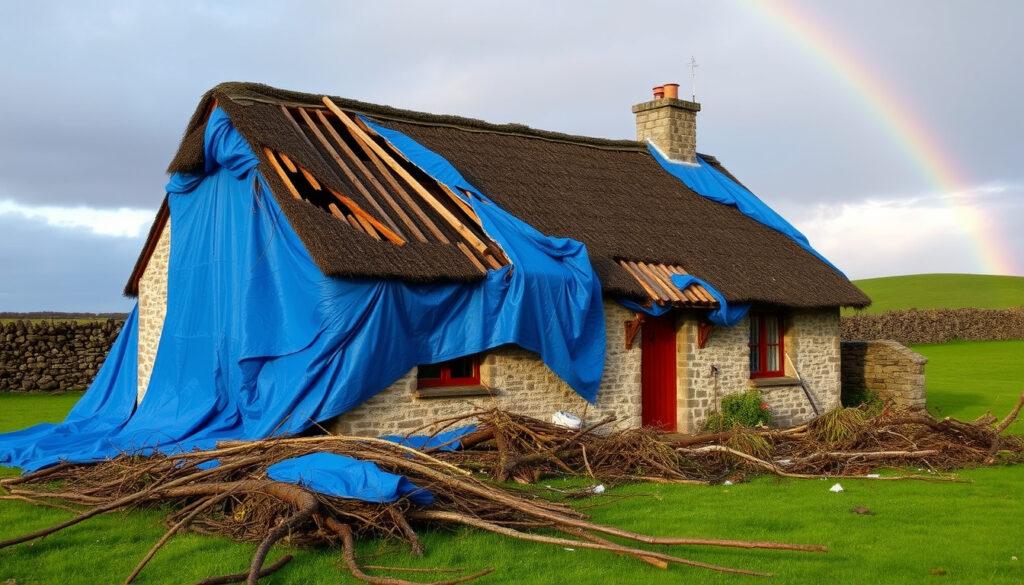
Board-up services come first when structures are compromised. Many homeowners wait too long before calling emergency contractors, allowing rain to cause secondary damage that the insurer may partially attribute to delay rather than the storm itself.
Board-up services come first when structures are compromised. Many homeowners wait too long before calling emergency contractors, allowing rain to cause secondary damage that the insurer may partially attribute to delay rather than the storm itself.
The implication: Official storm naming gives your claim solid ground, but policy wordings vary—check your schedule for specific exclusions before you need to claim.
What to do with storm damage?
Safety comes first—always. Stephen O’Connor’s guide for Irish policyholders (published by a loss assessor with direct storm claims experience) outlines the immediate steps that protect both your safety and your insurance claim.
Stay safe during power cuts
Storm damage often means power outages. Never touch fallen power lines, and keep at least 10 metres away from any downed cables. If using candles or open flames for light, never leave them unattended—storm-related fires are a documented risk. The Met Office (UK meteorological authority) advises staying indoors during severe wind events and avoiding travel unless absolutely necessary.
Initial assessment steps
Once conditions are safe, begin documenting everything. Photograph and video all damage from multiple angles before touching anything. If your roof has been compromised, Stephen O’Connor recommends covering damaged areas with tarpaulins if it’s safe to do so—this prevents secondary water damage that insurers may question if left unaddressed. Shut off water supplies if you detect leaks. Remove standing water and begin drying affected areas where possible.
The storm damage claims process involves several stages:
- Report damage to your insurer
- Inspection by a loss adjuster
- Preparation of repair estimates
- Agreement on settlement value
- Payment followed by completion of repairs
This process is outlined by HKP Loss Adjusters.
The implication: Speed matters—documenting everything before repairs begin protects your claim, and calling emergency contractors immediately prevents secondary damage that insurers may attribute to delay.
What does storm damage cover?
Storm damage insurance covers a broader range of repairs than many homeowners realise. HKP breaks down the specific categories that fall within typical Irish policy coverage.
Roof and chimney repairs
Wind damage to roofs—including missing or broken tiles, damaged flashing, and compromised structural elements—is covered by standard storm damage insurance. Chimney damage from falling trees or debris is also typically included. The settlement often covers not just the repair but also any necessary scaffolding or specialist access equipment required to complete the work.
Water and flood restoration
Water ingress resulting from storm-related roof or wall damage is covered. This means if wind damage created a gap in your roof and rain subsequently flooded your attic and upper floor, that water damage falls under the same storm event claim. However, pure flooding from rising water tables or river overflow may require separate flood coverage—check your policy wording carefully.
Window replacement and plumbing fixes both fall within typical storm damage coverage when caused directly by the storm event. HKP confirms that damage to outbuildings, garages, and boundary walls is covered subject to policy limits.
For Irish homeowners, the scope of storm coverage is actually quite broad—roofs, windows, water damage, outbuildings. The trade-off is that extensive claims take time: four to six weeks minimum for substantial repairs, longer if rebuilding is involved.
The pattern: Coverage is broad but settlements are slow—documenting thoroughly and filing fast keeps the process on track despite the multi-week timeline.
What is the 30/30 rule for storms?
The 30/30 rule is a lightning safety guideline endorsed by meteorological authorities worldwide. The rule has two parts: if you count 30 seconds or less between a flash of lightning and the sound of thunder, seek shelter immediately. Once you hear no thunder for 30 minutes after the last observed flash, it is generally safe to go outside again.
Lightning safety facts
Lightning can strike up to 10 miles from a storm’s rainfall area—so blue skies overhead do not guarantee safety. In Ireland, the Met Office (UK authority with shared weather patterns affecting Ireland) emphasizes that seeking proper shelter means being inside a substantial building or a fully enclosed metal vehicle, not beneath a tree or near open water.
When to seek shelter
Any thunder—even distant rumbling—should trigger the 30/30 countdown. The rule assumes you’re outdoors; if you’re already inside when the storm arrives, you have a significant safety advantage. Indoor safety during storms also extends to avoiding contact with plumbing, electrical fixtures, or windows during the event.
Outdoor workers, farmers, and anyone caught in open terrain face a stark choice: the 30/30 rule exists because waiting “just a few more minutes” has fatal consequences. When thunder sounds, that countdown starts immediately—no exceptions. The Met Office recommends staying indoors during severe wind events and avoiding travel unless absolutely necessary.
The implication: Lightning danger extends far beyond visible rain—waiting for blue skies is not a safe strategy, and shelter decisions must start the moment thunder is heard.
What was the worst storm in Ireland?
The Night of the Big Wind in January 1836 remains the most destructive storm in Irish meteorological history. Sustained winds estimated at over 100 mph swept across the entire island, causing widespread destruction to buildings, ships, and coastline structures. The storm killed approximately 100 people and left many more homeless.
Night of the Big Wind history
Historical records from the Met Éireann climate archive (Ireland’s national meteorological service) confirm that the 1836 storm’s ferocity exceeded anything recorded before or since in terms of widespread structural damage across multiple counties. Entire villages were affected, and the economic impact was severe for an era when many buildings were less structurally sound than today’s constructions.
Storm Eowyn comparison
Storm Eowyn, which struck Ireland in January 2025, produced what Met Éireann (Ireland’s national weather service) recorded as the highest sustained 10-minute mean wind speed measured in the west-southwest region since records began. While Eowyn caused extensive damage to modern infrastructure—power lines, trees, roof structures—it’s difficult to make direct historical comparisons because measurement techniques have changed dramatically since 1836.
What meteorologists do agree on: both storms represent extreme ends of Ireland’s wind climate. Whether Eowyn “surpassed” the Night of the Big Wind remains genuinely debated—not because one was weaker, but because we lack consistent measurement data from 1836 to make the comparison definitive.
For insurers, historical storm data informs risk pricing. For homeowners, it demonstrates that “worst on record” isn’t a static concept—each generation faces its own extreme weather events, and preparation matters more than comparing which storm was technically stronger.
Related reading: Best Dentist Near Me: How to Find Top Local Care in Ireland · Best Steakhouse Near Me: Dublin & Ireland Top Picks
omcclaims.ie, pcla.co.uk, pdla.ie, insuremyhouse.ie, allianz.ie, campion.com
Frequently asked questions
How much does auto insurance go up after a claim?
The increase depends on several factors: the type of claim, your claims history, the insurer’s pricing model, and whether you have protection through a no-claims bonus. On average, a single claim may increase premiums by 20-30%, but this varies widely. Irish insurers typically review each case individually rather than applying a fixed penalty formula.
Are there big storms in Ireland?
Ireland experiences regular Atlantic storms, particularly during autumn and winter months. Named storms like Eowyn, Barra, and Ophelia have caused significant damage in recent years. The island’s western exposure makes it particularly vulnerable to wind and rain systems moving east from the Atlantic.
What is classed as storm damage?
Storm damage typically includes wind damage to buildings, roof structures, windows, and cladding; water ingress through storm-damaged roofs or walls; damage from falling trees, branches, or debris; and damage to outbuildings, garages, and boundary structures. The event must generally be classified as a named storm by meteorological authorities for standard policies to apply.
Can you go outside in 40 mph winds?
The Met Office advises avoiding outdoor exposure in sustained 40 mph winds. At this threshold, walking becomes difficult, tree branches can break and fall, and loose objects become hazardous projectiles. Sustained winds above 40 mph are classified as “damaging” and warrant staying indoors unless absolutely necessary.
Storm damage restoration near Dublin?
Restoration services in Dublin include emergency board-up contractors, roofing specialists experienced with insurance claims, water damage restoration firms with industrial drying equipment, and loss assessors who can advocate on your behalf. Major providers operate 24/7 for emergency callouts. Always request references and verify insurance validation before engaging contractors.
Storm damage restoration near Ireland?
Restoration services operate across all Irish counties, with higher concentration in urban areas like Dublin, Cork, and Galway. Rural properties may face longer response times but specialist firms regularly travel to outlying areas. Search for local contractors with verifiable credentials and check whether your insurer has preferred supplier networks that may simplify claims processing.
How to stay safe in a power cut?
During a power cut from storm damage: keep refrigerator and freezer doors closed to preserve food; use torches rather than candles where possible; avoid carbon monoxide poisoning from generators or barbecues used indoors; check on vulnerable neighbours; report fallen power lines to ESB Networks immediately; and keep mobile phones charged from power banks. If using a generator, place it outdoors in a well-ventilated area.
Summary
Storm damage restoration in Ireland sits within robust insurance coverage, but the path from damage to repair runs through documentation, timely reporting, and understanding your policy’s specific terms. For homeowners, the sequence is clear: secure the property safely, document everything, notify your insurer, engage quality contractors, and brace for a settlement timeline of weeks rather than days. Those who move fastest while documenting thoroughly tend to achieve the smoothest outcomes.
More related posts
 Cheap .shop Domain Hostinger – 2025 Prices from $1.49 Guide
 Seven Deadly Sins List, Order, and Meanings
 Sound Bar for TV: Best Picks & Buyer’s Guide Ireland
 Roth IRA Contribution Limits 2025 & 2026: Key Updates
 Detroit Lions Game Today: Channel, Time, Score & How to Watch
 Nitto Terra Grappler G3 Review: Performance, Specs & Tires
 Alaska Permanent Fund Dividend 2025 – $1,000 for Residents