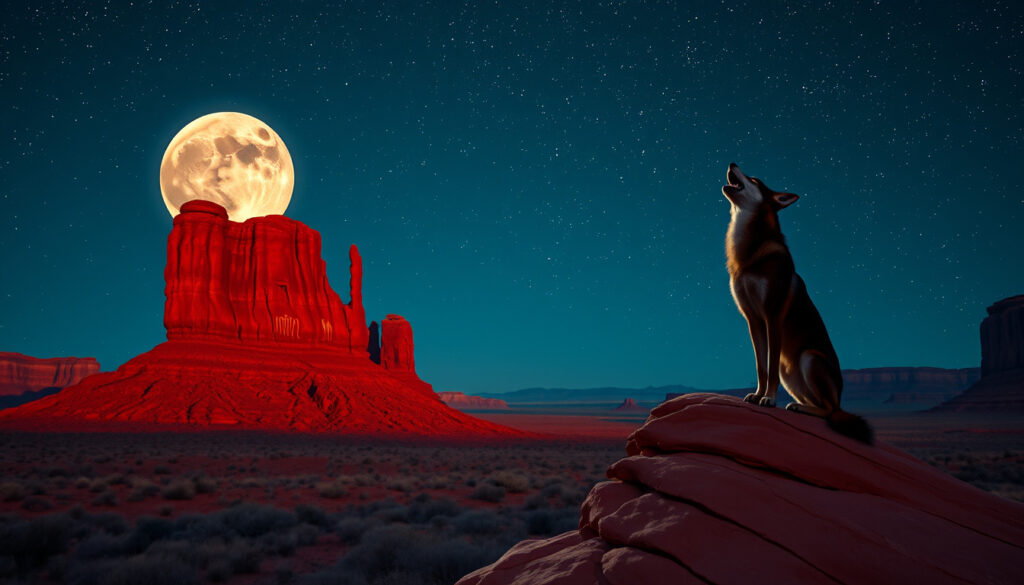
What Is a Skinwalker? Navajo Lore Explained
If you’ve spent any time in online paranormal communities, you’ve probably seen the word “skinwalker” pop up more than a few times—often in breathless posts about strange sightings in rural Utah or Arizona. Most of what circulates online doesn’t match what the Navajo people themselves say about these beings. The real tradition is older, more serious, and far more bound to cultural context than internet folklore suggests. Here’s what the record actually shows.
Cultural Origin: Navajo (yee naaldlooshii) ·
Primary Ability: Shape-shifting into animals ·
Classification: Harmful witch ·
Region: Four Corners area (CO, UT, AZ, NM)
Quick snapshot
- Defined in Navajo culture as witches (History.co.uk mythology guide)
- Navajo term: yee naaldlooshii (History.co.uk cultural reference)
- Taboo to discuss with outsiders (Wikipedia ethnographic entry)
- Real-world existence beyond oral tradition
- Verified sightings with documentation
- Exact origins predating written record
- Navajo Witch Purge of 1878: 40 suspected witches killed (Legends of America historical account)
- Sherman family reports at Utah ranch publicized in 1996 (All That’s Interesting investigative report)
- Ranch purchased by Brandon Fugal in 2016 (HowStuffWorks paranormal analysis)
- Ongoing cultural preservation efforts by Navajo elders
- Continued paranormal interest amid lack of scientific evidence
The table below consolidates verified attributes of skinwalkers as documented across multiple Navajo cultural sources.
| Field | Value |
|---|---|
| Navajo Term | yee naaldlooshii |
| Type | Harmful witch (‘ánti’įhnii’) |
| Abilities | Turn into animals, possess beings, mimic voices |
| Origin Region | Four Corners (CO, UT, AZ, NM) |
| Initiated Through | Witchery Way ritual |
| Weakness (per lore) | Silver or fire; killed only by white ash-coated weapons |
What Do Skinwalkers Look Like?
Skinwalkers don’t have a fixed appearance—they can assume animal forms, which makes them difficult to identify. According to Navajo oral tradition, they most commonly transform into coyotes, wolves, foxes, cougars, dogs, and bears. In these animal forms, they reportedly move faster than normal animals and are said to be impossible to catch. When they take human form, observers describe subtle wrongness: features that don’t quite match, movements that seem slightly off.
Traditional descriptions
Legends describe skinwalkers as once being human healers who turned to darker purposes. The term yee naaldlooshii, meaning “with it, he goes on all fours,” reflects this transformation motif. In human form, they may retain animal characteristics—a slight distortion of the face, eyes that reflect light unusually, or an unsettling gait. According to sources like EBSCO Research Starters, they are classified as ‘ánti’įhnii’, the harmful witches that stand in direct opposition to medicine men who use spiritual knowledge for healing.
Common animal forms
The most frequently reported animal forms come from the Four Corners region’s wildlife: coyotes and wolves appear most commonly in alleged sightings, followed by foxes and large cats. Bears are mentioned less often but appear in accounts from the Ute tribe’s traditions. These choices make sense given the regional ecosystem. Notably, skinwalkers in animal form reportedly can read thoughts—a power that persists regardless of which animal they become. Legends of America notes that this ability allows them to know private details about people they’re targeting.
Do Skinwalkers Exist?
This question sits at the center of debate between cultural preservation and paranormal enthusiasm. Within Navajo belief, skinwalkers are absolutely real—they are part of a spiritual framework where witchcraft and protective medicine both exist as tangible forces. However, no scientific evidence supports their existence outside this cultural context. Skeptics point to the lack of verifiable documentation and suggest that many “sightings” stem from normal wildlife behavior misidentified through the lens of legend.
Navajo cultural belief
Navajo tradition treats skinwalkers as one type of harmful witch within a broader spiritual taxonomy. According to Wikipedia’s coverage of the subject, they belong to the ‘ánti’įhnii’ category—beings who use their spiritual knowledge for malevolent purposes rather than healing. This classification isn’t metaphorical; it’s categorical within the belief system. The culture’s taboo against discussing skinwalkers with outsiders stems from the belief that speaking about them can invoke their attention. This taboos serves as both protection and enforcement of the line between knowledge that should stay within the community.
Modern sightings
The most famous modern reports come from Skinwalker Ranch, a 512-acre property in Utah’s Uintah Basin. The Sherman family reported multiple phenomena starting in the 1990s, including UFOs, cattle mutilations, crop circles, and alleged skinwalker sightings. Researcher Colm Kelleher described finding tracks at the ranch that didn’t match any known animal—”a bird of prey, maybe a raptor print, but huge and, from the depth of the print, from a very heavy creature.” The ranch was purchased by Brandon Fugal in 2016, who subsequently reported UFO activity on the property.
Every documented “sighting” lacks independent verification. The most compelling accounts come from one property, and the same ranch has been connected to UFO claims, cattle mutilations, and alleged portal phenomena—making it difficult to isolate skinwalker claims from a broader pattern of anomalous reports.
How to Tell if Someone Is a Skinwalker?
In folklore, identifying a skinwalker requires attention to behavioral patterns and physical inconsistencies. The challenge is that skinwalkers can take human form and move freely among communities, making detection difficult. The signs most commonly cited come from years of accumulated tradition and modern alleged witness accounts.
Behavioral signs
According to accounts compiled by sources like HowStuffWorks, skinwalkers in human form may know information they shouldn’t have—personal details shared only in private conversations, secrets from family discussions, or knowledge of events before they happen. This mind-reading ability is one of the most consistent warning signs across multiple traditions. Additionally, they may display unusual knowledge of ceremonies or ritual language that a normal person wouldn’t possess.
Physical indicators
When in human form, skinwalkers reportedly have eyes that glow yellow or reflect light abnormally—particularly visible in photographs or when caught in headlights. Their movements may appear slightly unnatural: a gait that’s almost right but off in some subtle way, or reflexes that seem too fast for a human. Historic Mysteries notes that skinwalkers infiltrate communities using animal forms to hide, then switch to human appearance when convenient—making any sudden or unexplained behavioral changes potential warning signs.
Many Navajo people explicitly advise against focusing on detection methods. Discussing skinwalkers at all—even to catalog their traits—is considered potentially dangerous because it invites their attention. Traditional guidance emphasizes spiritual protection and avoidance rather than confrontation or study.
What Does a Skinwalker Do to Humans?
The Navajo tradition frames skinwalkers as fundamentally harmful beings—witches who have turned their spiritual knowledge toward destructive ends. Their activities include causing illness, taking control of animals or people, and conducting rituals that harm the broader community. Understanding these capabilities helps explain why the topic remains sensitive within the culture.
Harmful actions
Skinwalkers reportedly use their abilities to cause physical illness in their targets—sometimes through direct contact, sometimes from a distance through ritual means. Wikipedia’s coverage describes them using powers for “evil ceremonies, manipulative magic.” They may mimic the voices of family members to lure people out of safety, a tactic that makes the legend particularly unsettling. According to Legends of America, the Witch Purge of 1878 resulted in 40 suspected skinwalkers being killed by the community in an effort to restore tribal harmony after a series of illnesses and misfortunes were attributed to their activities.
Possession abilities
Beyond physical harm, skinwalkers reportedly can possess animals and, in some accounts, humans. This possession allows them to spy on communities, gather information, and extend their reach beyond what a single human or animal form would permit. HowStuffWorks documents abilities including speed, mimicry, and what sources describe as “mind control beyond shapeshifting”—a suite of capabilities that makes them particularly dangerous in the traditional framework.
How Do People Turn Into Skinwalkers?
The transformation from ordinary person to skinwalker isn’t accidental or random—it requires deliberate action through a specific initiation path called the Witchery Way. This process involves taboo acts that break fundamental social bonds, making the transformation both spiritual and social.
Ritual requirements
According to HowStuffWorks, the initiation into the Witchery Way requires committing the ultimate taboo: killing a family member. This act serves as a breaking point that corrupts the individual’s spiritual balance and opens them to the darker powers. The knowledge of these rituals is passed down through specific lineages, meaning skinwalkers aren’t self-taught—they have teachers who guide them through the process.
Breaking taboos
The kill-a-family-member requirement isn’t arbitrary—it’s rooted in the understanding that someone willing to destroy their closest bonds has fundamentally severed themselves from normal human community. History.co.uk notes that skinwalkers were originally community healers who turned to evil through corruption by power, suggesting the transformation reflects a moral descent as much as a ritual one. Wearing the skin of the victim is mentioned in some accounts as part of the initiation, cementing the connection between the witch and their first kill.
The requirement to kill a family member explains why skinwalker cases are rarely prosecuted—any community member with the knowledge to identify a skinwalker also carries the cultural taboo against discussing them. The Witch Purge of 1878 stands as a notable exception, where community fear overcame the normal silence.
Regional Variations and Related Traditions
While Navajo tradition provides the most detailed accounts, skinwalker-like legends appear across multiple Native American tribes in the Southwest. These variations share common themes but differ in specific details, reflecting the interconnected cultures of the Mesa Verde region.
The Ute tribe has its own skinwalker traditions, notably believing that the Navajo cursed them with these beings. According to Legends of America, the Ute actively avoid Skinwalker Ranch and the surrounding area, making it one of the few Native American communities that treats the location as spiritually dangerous rather than just geographically connected to the legend.
The Hopi and Apache share similar traditions of malevolent animal-transforming witches. Grunge reports that these tribes feature shapeshifting witch lore with regional variations—the Hopi version emphasizes different animal forms, while Apache traditions incorporate the practice into their own broader spiritual framework. Pueblo peoples, who settled the area at least 7,000 years ago according to Grunge, share cultural connections that suggest these traditions may share common origins.
“Rooted in Navajo (Diné) tradition, the skinwalker—often called yee naaldlooshii, ‘with it, he goes on all fours’—is not a cryptid or campfire monster, but a deeply serious and taboo figure.”
— History.co.uk coverage of Native American mythology
“The Navajo legend of skinwalkers has received a lot of attention thanks to the growing notoriety of Skinwalker Ranch – a Utah hotspot of bizarre phenomena.”
— HowStuffWorks paranormal investigation coverage
Navajo elders and cultural leaders consistently urge outsiders to respect the taboo against discussing skinwalkers. The cultural prohibition exists because, within the tradition, speaking about these beings can invoke their attention—a risk that many community members take seriously rather than treating as mere superstition.
What the Evidence Does and Doesn’t Support
The cultural record of skinwalkers is rich and detailed—Navajo tradition provides clear accounts of their origins, capabilities, and methods. What remains absent is physical evidence that holds up to scientific scrutiny. The gap between cultural belief and paranormal claim is significant.
All documented sightings trace back to oral accounts, personal reports from property owners, or secondhand retellings. The concentration of “evidence” at Skinwalker Ranch—tracks, sightings, anomalous phenomena—comes from a single location with a documented history of diverse unexplained events. Multiple claims point to simultaneous UFO activity, cattle mutilations, and alleged skinwalker appearances, making it difficult to isolate any single phenomenon for verification.
Skeptics correctly note that without physical evidence, documentation, or reproducible observations, these claims remain anecdotal. The lack of scientific study doesn’t prove skinwalkers don’t exist—it simply leaves the question in the realm of belief versus unverified report. For those interested in Navajo tradition specifically, the answer is straightforward: skinwalkers are real within that spiritual framework. For those seeking physical evidence, the record remains empty.
Related reading: As Above So Below meaning and origins · Is the Moon a Planet
grunge.com, ebsco.com, encyclopedia-of-monsters.fandom.com, history.denverlibrary.org
Frequently asked questions
Can a skinwalker hurt you?
According to Navajo tradition, skinwalkers actively seek to cause harm—through illness, possession, or other means. The legends frame them as malevolent beings using their powers for destructive purposes rather than neutral observation.
Are skinwalkers dangerous?
Within Navajo cultural belief, skinwalkers are among the most dangerous figures in their spiritual framework. The 1878 Witch Purge, which resulted in 40 deaths, demonstrates how seriously the community took the threat they posed.
What is a skinwalker weakness?
Traditional accounts mention silver or fire as weaknesses. All That’s Interesting reports that skinwalkers can reportedly be killed only by a bullet or knife dipped in white ash—a substance connected to ritual purification in some accounts.
How to tell if a skinwalker is near you?
Common signs mentioned in lore include: animals behaving abnormally, sudden temperature drops, feeling watched, unexplained knowledge of private information, and sightings of animals with unusual features or behaviors. Many Navajo people advise against actively looking for these signs, as discussing skinwalkers is itself considered potentially dangerous.
Are skinwalkers real in real life?
This depends entirely on the framework being applied. Within Navajo spiritual belief, skinwalkers are real beings who cause genuine harm. No scientific evidence confirms their physical existence outside of cultural tradition. Modern alleged sightings lack independent verification and are concentrated around a single property with a history of diverse anomalous claims.
What is a skinwalker animal?
Skinwalkers commonly take the form of coyotes, wolves, foxes, cougars, dogs, and bears. These animals are native to the Four Corners region where the tradition is strongest. In animal form, they reportedly move faster than normal animals and can read thoughts.
How to become a skinwalker?
According to tradition, becoming a skinwalker requires initiation into the Witchery Way, which includes killing a family member as the central requirement. This knowledge is passed down through specific lineages rather than discovered independently. The act represents a complete severance from normal human community and morality.
For those encountering skinwalker lore online, the gap between internet retellings and actual Navajo tradition is substantial. Online content often amplifies horror elements while stripping away cultural context—the very taboos that Navajo culture maintains around this topic exist because discussing these beings is considered dangerous within the tradition itself. The most respectful approach acknowledges the beliefs on their own terms rather than reducing them to cryptid entertainment.
More related posts
 Atlanta Hawks vs Miami Heat Match Player Stats & Analysis
 Symptoms of STD in Female – Key Signs and When to Test
 Card Shows Near Me: 2025-2026 Ireland Events Guide
 Screech Saved by the Bell – Dustin Diamond’s Life and Death
 Ulta Gift Card Balance: Check Online, Steps & Expiration
 A Song to Drown Rivers: Summary, Review, and Reader Guide
 Old Navy Black Friday 2025: Sale Dates, Deals & Tips
 Chick-fil-A Near Me: Locations, Menu, Breakfast Hours & UK Guide