Shut the Box Game: Rules, Strategy, and Age Guide (2025)
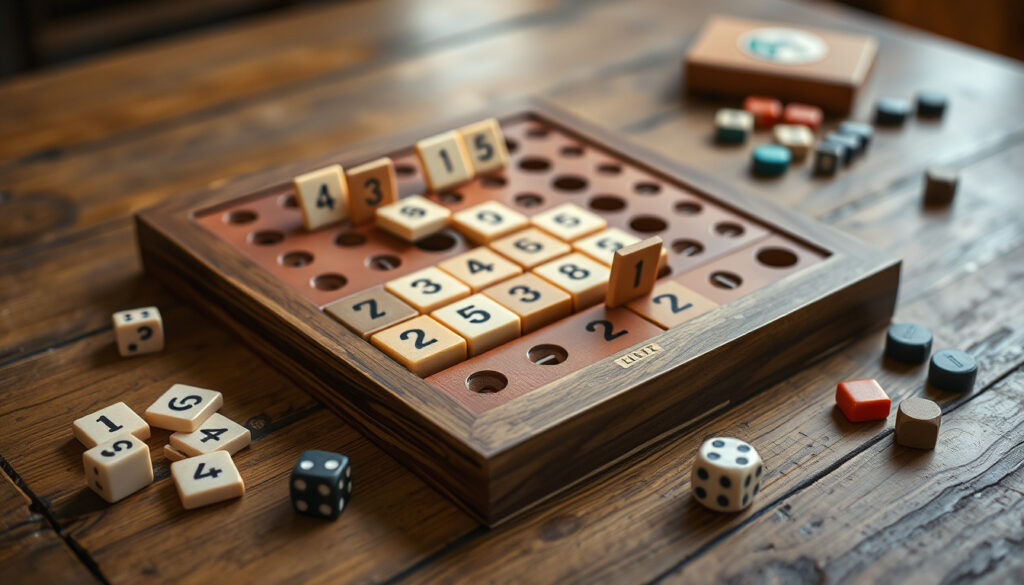
A wooden box with hinged tiles and a pair of dice doesn’t look like much — but for generations it’s been the centerpiece of pub tables and family game nights. Known as Shut the Box, this deceptively simple dice game challenges players to close numbered tiles by rolling totals that match their sums. What keeps people coming back is the clever blend of luck and quick mental math, a combination that works just as well for a 7-year-old learning addition as it does for an adult plotting a strategic run.
Players: 1–4 ·
Age range: 6+ ·
Average game length: 10–20 minutes ·
Dice used: 2 standard six-sided dice ·
Tile configuration: Numbers 1–12 (or 1–10 or 1–9) ·
Difficulty: Easy to learn, with strategic depth
Quick snapshot
- Shut the Box is played with two dice and numbered tiles (according to Wikipedia)
- The player who shuts all tiles wins immediately (per YouTube tutorial)
- The game is a traditional English pub game (Wikipedia)
- Exact origin year (various dates between 1700s and 1800s, per Wikipedia)
- Whether the game originated in Normandy or England (some sources suggest Norman origins) (Wikipedia)
- First documented in 19th-century England, possible earlier roots (Wikipedia)
- Gained popularity as a pub gambling game before family adoption (Wikipedia)
- Free online versions and mobile apps make the game accessible anywhere
- Classroom adoption growing as a low‑tech math teaching tool
Six key facts, one pattern: the game’s flexibility makes it equally at home in a pub and a classroom.
The table below summarizes the core specifications that define the game.
| Label | Value |
|---|---|
| Number of tiles | 10, 12, or 9 depending on version |
| Typical set includes | Wooden box with hinged tiles, two dice |
| Game origin | England, 19th century (possibly earlier) |
| World record lowest score in 10 rounds | 0 (multiple documented cases) |
| Tiles configuration | Numbers 1–9, 1–10, or 1–12 |
| Multiplayer setup | Each player has their own set of tiles |
How do you play the Shut the Box game?
You don’t need a rulebook thicker than a coaster: Shut the Box teaches itself in a single round.
Basic setup and equipment
- Wooden box with 9, 10, or 12 hinged tiles (each numbered consecutively)
- Two standard six‑sided dice
- Optional: score sheet for tournament play
The classic version uses tiles 1 through 9, as described by Wikipedia. Some modern boards extend to 12, a variation covered in YouTube tutorials.
Rolling and choosing tiles
- Roll both dice into the box (if any of 7, 8, or 9 remain open, you must roll both); otherwise you may roll one or two, per Masters Traditional Games
- Shut one or more open tiles whose sum equals the dice total
- Continue rolling until you cannot make a legal combination
As Games for Young Minds points out, a roll of 9 can be matched by 9, 8+1, or 6+3 — the player chooses which tiles to flip.
What happens when you cannot shut a tile
If no open tiles add up to the dice total, your turn ends immediately. You then score the sum of all remaining open tiles, according to Masters Traditional Games.
The pattern: every roll forces a quick mental addition exercise. The game rewards players who keep multiple options open — a skill that improves with practice.
What are the rules of close the box?
Starting the game
All tiles begin upright (open). For multiplayer, the player with the highest initial roll goes first, according to The Pool Shoppe instructions. Each player plays their own set of tiles.
Legal moves
- You must use the exact dice total to shut tiles — no rounding, no partial sums.
- You may shut one tile (e.g., shut 9 on a roll of 9) or multiple tiles (e.g., 6+3 on a roll of 9).
- Once a tile is shut, it stays shut for the remainder of your turn.
End of turn and scoring
When you cannot form a legal combination, your score is the sum of all still‑open tiles. As Dice Game Depot explains, the objective is to shut as many numbers as possible; the player with the lowest score wins.
The catch: if you manage to shut every tile, you “shut the box” and win immediately — regardless of other players’ scores. That instant‑win moment is what keeps players coming back.
What is the point of Shut the Box game?
The game turns abstract probability into a tactile challenge: every dice roll is a decision fork.
Objective of the game
The goal is to close all tiles. If that happens, the game ends on the spot. If no one shuts the box after all players have taken a turn, the lowest total of open tiles wins.
Variations in scoring
- Some house rules play a set number of rounds (e.g., 10 rounds) and total scores.
- Other variations treat the game as a single‑round race to zero.
- The shifting threshold forces players to adapt: a low score in one round doesn’t guarantee a win.
Historical gambling origins
Originally a pub gambling game, players would contribute to a pool and the winner took all. Wikipedia notes that the game was also known as “batten down the hatches” and “trick‑track” — a sign of its long history in English drinking establishments.
The implication: the game’s gambling roots explain its simple, instant resolution. It was designed to settle bets quickly, not to fill an evening.
What age is Shut the Box good for?
Recommended age range
Most manufacturers recommend age 6 and up, according to Masters Traditional Games. The basic addition required makes it accessible to early elementary students.
Why it’s good for children
The Museum of Dufferin highlights the game as a tool for teaching addition and subtraction. Each turn requires mental math under mild pressure — a low‑stakes way to practice arithmetic without a workbook.
Appeal for adults and families
Adults enjoy the strategic layer: which tiles to close, when to take risks, and how to read probability. The game fits into a short attention span — a full round often wraps up in 10–20 minutes, making it a favorite for family game nights.
The trade‑off: younger children may need help with larger sums (especially on a 12‑tile board), while adults may find the luck element too dominant in single rounds. Playing multiple rounds balances the scales.
Is there a trick to Shut the Box?
Luck vs. skill
The dice introduce randomness, but the choice of which tiles to shut is pure skill. Geeky Hobbies notes that multiple legal combinations often exist for a single roll — deciding wisely is what separates the occasional winner from the consistent player.
Common strategies
- Shut higher numbers first (they offer fewer combinations later, so getting them out early reduces future risk).
- Keep lower numbers open longer (they are easier to match with a single die when you’re rolling one die).
- On the first turn, aim to close 7, 8, or 9 to unlock the single‑die option sooner.
Difficulty level explained
The game is easy to learn — you can explain it in 30 seconds — but mastering the probability behind tile selection takes practice. YouTube tutorials often compare it to blackjack: the rules are simple, but the depth is real.
The pattern: consistency comes from recognizing that the dice create repeatable probability patterns. Once you start noticing that a 7 is the most common two‑dice total, your tile‑closing decisions change.
Upsides
- Quick to learn and teach
- Portable — fits in a small box
- Reinforces mental math for children
- Suitable for solo play or groups up to 4
- Minimal setup (just open the box and roll)
Downsides
- Luck can dominate in single rounds
- Limited strategic depth for experienced players
- Replay value can wane without variations
- Physical box may not fit in a standard board‑game shelf
How to play Shut the Box step by step
- Set up the tiles. Open all tiles so numbers face up.
- Roll the dice. If 7, 8, or 9 are still open, roll both dice. Otherwise, you may roll one or two.
- Choose tiles to shut. Shut any open tiles that add up to the dice total. You may shut one tile (e.g., shut 9 on a roll of 9) or multiple (e.g., 6+3 on a roll of 9).
- Repeat steps 2–3 until you cannot make a legal combination.
- Score your turn. Add up the numbers still open. That’s your score.
- Next player. Reset all tiles for the next player. After all players have taken a turn, the lowest score wins.
- Shut the box. If you manage to close every tile, you win immediately — the game stops.
What we know and what remains uncertain
Confirmed facts
- Shut the Box is a traditional English pub game played with two dice and numbered tiles (Wikipedia)
- The player who shuts all tiles wins immediately (YouTube tutorial)
- Rules require the dice total to match the sum of tiles shut (Masters Traditional Games)
What’s unclear
- Exact origin year (estimates range from 1700s to 1800s)
- Whether the game was first played in Normandy or England
What the experts say
“Shut the Box is a traditional pub game, also known as batten down the hatches. Players roll dice and flip down numbered tiles that correspond to the dice total.”
— Wikipedia (encyclopedic reference)
“The object is to close all the numbers, or failing that, to have the lowest total at the end of the game.”
— Masters Traditional Games (rules authority)
For a parent considering the game for a 7‑year‑old, the verdict is straightforward: it delivers genuine arithmetic practice wrapped in a pub‑game shell. For an adult looking for a quick social game, the luck‑skill balance offers just enough tension to stay interesting. Shut the Box is what its players make of it — a drill, a gamble, or a teaching tool, all from a box of hinged tiles.
For a comprehensive overview of the classic dice game, the Shut the Box game rules provides detailed rules and strategy tips.
Frequently asked questions
Can Shut the Box be played alone?
Yes. Solo play follows the same rules: try to shut all tiles. Many players use it as a solitaire challenge or practice tool.
What happens if you roll doubles?
Doubles are treated like any other roll — you shut tiles whose sum equals the total of both dice. No special bonus or penalty.
How do you win in a multi‑player game?
If any player shuts all tiles, they win immediately. Otherwise, the player with the lowest sum of open tiles after each has taken a turn wins.
Are there different versions of the tiles?
Yes. The most common are 1‑9, 1‑10, and 1‑12. Some boards have 12 tiles but players may choose to use only 1‑9 for a shorter game.
Is Shut the Box suitable for classroom use?
Yes. The Museum of Dufferin notes its value for teaching addition and probability in a low‑tech, engaging format.
What is the best strategy to shut the box?
Prioritize shutting high numbers early, keep low numbers open as options, and learn the probability distribution of two dice (7 is the most likely total).
How long does a typical game take?
A single round takes 10–20 minutes. Multiple rounds can extend to 30–40 minutes, depending on player count.
More related posts
 Oreimo: Plot, Ending & Controversy Explained
 Chinese Satellite Pulverizes Starlink With 2-Watt Laser
 Jeff the Land Shark: Origin, Powers, MCU & Deadpool
 January 1 California Pet Law: 2026 Changes Explained
 Storm Damage Restoration Near Me | Ireland Guide & Services
 Is Luke Combs’ ‘Where the Wild Things Are’ a Real Story
 Where Is Liberty University – Lynchburg VA Campus Address