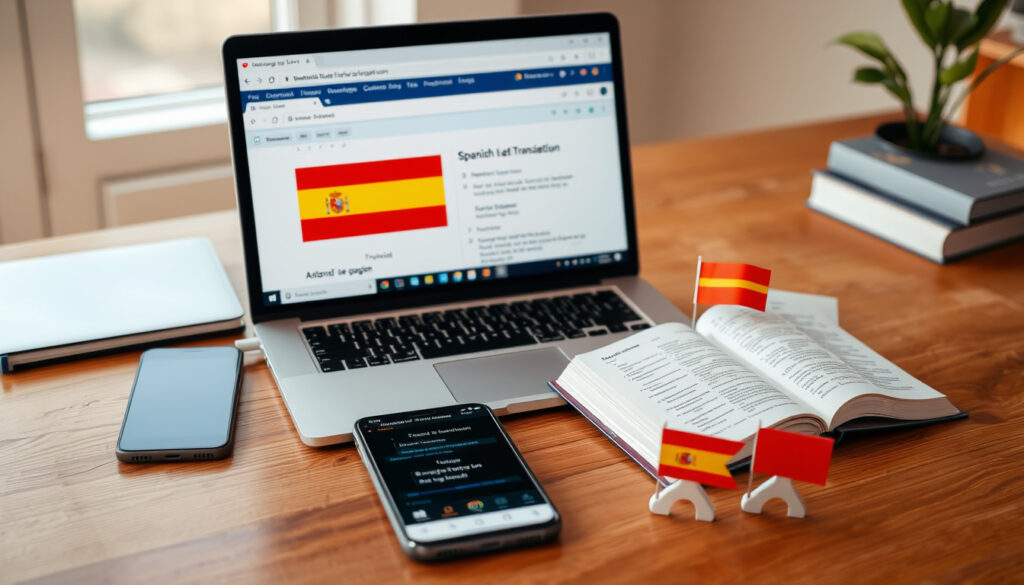
Spanish to English Translate: Best Free Tools Compared
If you have ever tried to translate Spanish to English on the fly, you already know: not every tool is equally reliable. As Maestra AI, a translation technology platform, notes, no machine translator is 100% accurate, but some come close. This guide cuts through the marketing claims to show what each major free service actually delivers.
Google Translate languages: 243+ (EHLION, a language services provider) ·
AI translation accuracy: 80–90% for common pairs (Smartcat, a language technology platform) ·
DeepL strength: natural-sounding sentences (Bluente, a translation industry blog)
Quick snapshot
- Google Translate supports over 243 languages for free (EHLION)
- DeepL is often preferred for natural-sounding sentences (Bluente Blog)
- Modern AI translation reaches 80–90% accuracy for straightforward text (Smartcat)
- Which tool is best overall depends heavily on text type and user needs (Bluente Blog)
- Accuracy for idiomatic expressions and slang varies greatly (Maestra AI)
- Future software updates may shift relative performance (Bluente Blog)
- Free translation apps continue improving but still struggle with complex text (Maestra AI)
- Neural machine translation has raised baseline accuracy but gaps remain (Maestra AI)
- Travelers should look for offline modes (Timekettle, a translation device maker)
- Business users may need professional software with quality checks (Smartcat)
Four translation tools, one clear pattern: no single service works best for every task. The table below lays out the essential differences between the top free options.
| Feature | Google Translate | DeepL | Microsoft Translator |
|---|---|---|---|
| Language support | 243+ languages (EHLION) | 31 languages (European focus) (EHLION) | 100+ languages, neural machine translation (EHLION) |
| Accuracy perception | Widely used, reliable for short text (Bluente Blog) | Often preferred for natural-sounding sentences (Bluente Blog) | High accuracy for common language pairs (Maestra AI) |
| Offline support | Yes, for basic translations (Timekettle) | Not mentioned in available research | Available through mobile app |
| Price | Free | Free tier available; pro version costs | Free |
| Best for | Quick single words and casual phrases (Bluente Blog) | Longer sentences and paragraphs that need fluent output (Bluente Blog) | General use with good context handling (EHLION) |
Bottom line: Google Translate and Microsoft Translator offer broad language coverage for free, while DeepL delivers arguably better sentence-level quality. Travelers and business users have different priorities — choose accordingly.
Upsides
- Free tools handle short common phrases with high accuracy (Maestra AI)
- DeepL excels at producing natural-sounding translations (Bluente Blog)
- Google Translate offers offline mode for basic needs (Timekettle)
- Microsoft Translator uses neural MT for contextual nuance (EHLION)
Downsides
- No machine translator is 100% accurate (Maestra AI)
- Accuracy drops with idiomatic expressions and formal writing (Maestra AI)
- Free tools often break formatting on documents (Bluente Blog)
- Dialect variations (Castilian vs. Latin American) are poorly handled (Timekettle)
What is the latest verified information about spanish to english translate?
How accurate are modern translation tools?
- No machine translator achieves 100% accuracy (Maestra AI, a translation technology platform)
- For common language pairs like Spanish→English, AI translation typically reaches 80–90% accuracy (Smartcat, a language technology platform)
- Performance varies dramatically by language pair and text type (Bluente, a translation industry blog)
The implication: while free translators are fine for casual use, anyone working on official documents or nuanced content should budget for human review.
Which tools are most recommended for Spanish to English?
- Google Translate remains the most ubiquitous and accessible tool (Umevo AI, an AI tool review site)
- DeepL is often recommended for paragraphs where natural flow matters (Bluente Blog)
- For voice translation and offline use, Google Translate leads (Timekettle, a translation device maker)
- Microsoft Translator offers strong neural MT support for general use (EHLION, a language services provider)
The pattern: your choice should align with whether you need speed (Google Translate), fluency (DeepL), or reliability across devices (Microsoft Translator).
What are the key differences between Google Translate and DeepL?
- Google Translate supports over 243 languages; DeepL covers 31 (EHLION)
- DeepL is widely recognized for more nuanced, natural output (Umevo AI)
- Google Translate excels at real-time web page translation and broad use cases (Transync AI, a translation guide site)
- DeepL provides a glossary feature for consistent terminology — missing in the free Google tier
The trade-off: Google Translate wins on reach and ease; DeepL wins on sentence-level quality for Spanish-English.
Even the best free tools can misinterpret regional Spanish variations. A phrase that works in Mexico may confuse in Spain — no machine handles dialect shifts reliably enough for professional use.
How to translate Spanish to English effectively: a step-by-step guide
- Define your context and needs. Are you translating a single word, a sentence, a full document, or a conversation? For short, common phrases, any free tool works. For formal writing or complex topics, plan extra time for review (Maestra AI).
- Choose the right tool for the task. For quick lookups, use Google Translate. For paragraphs that need natural flow, opt for DeepL. For voice translation on the go, Google Translate or Microsoft Translator (Bluente Blog).
- Review the translation critically. No machine is perfect. Check for idioms, slang, and proper nouns that may have been misinterpreted. Specialized content or rare language combinations may need human review (Smartcat).
- Use offline mode when disconnected. Google Translate offers offline downloads for basic Spanish-English translations, useful for travelers without internet access (Timekettle).
Confirmed facts
- Google Translate is free and supports 243+ languages (EHLION)
- DeepL provides high accuracy for natural-sounding Spanish-English translations (Bluente Blog)
- Free apps handle short sentences and common phrases well (Maestra AI)
- Professional translation software adds terminology management and quality checks (Smartcat)
What’s unclear
- Which tool is best overall remains dependent on text type and user need (Bluente Blog)
- Accuracy for idiomatic expressions, slang, and formal writing varies widely (Maestra AI)
- Future updates may shift relative tool performance
- Rankings for the “most accurate” tool differ across independent tests
“No translator is 100% accurate. Free apps handle short sentences and common phrases well, but accuracy drops with longer text, idioms, or formal writing.”
— Maestra AI, translation technology platform
“Performance varies dramatically depending on the language pair being translated. For Spanish to English, DeepL is often preferred for natural-sounding sentences and paragraphs.”
— Bluente, translation industry blog
For anyone needing Spanish to English translation, the choice is not between good and bad but between suitable and unsuitable. The right tool depends on your specific text: for casual phrases, Google Translate is hard to beat; for documents, DeepL may save you hours of editing. Free translation software is powerful, but its limits mean that professional review is still essential for accuracy-critical work. For the business user in a Spanish-speaking market, the decision is clear: invest in a tool that fits your text type, or pay the price in misunderstanding.
Related reading: 5000 Pesos to Dollars: MXN to USD Rates & Converter Guide · Argentina National Team 2026: Messi’s Future, Squad & Brazil
Frequently asked questions
How to translate Spanish to English on a mobile device?
Download the Google Translate app (iOS/Android) for instant text and voice translation. DeepL and Microsoft Translator also offer mobile apps. All support typing, speaking, and camera input for real‑time translation.
Can I translate Spanish to English without an internet connection?
Yes. Google Translate allows you to download Spanish and English language packs for offline use. Basic translations still work without data, though quality may be reduced for longer phrases.
Is it better to use a human translator or machine translation for Spanish to English?
For quick, casual translations, machine tools are fine. For legal, medical, or marketing content, a human translator or professional software with human review is strongly recommended, as machine accuracy drops below 90% with complex text (Smartcat).
What is the best free Spanish to English translator?
There is no single “best” — it depends on your task. Google Translate excels in language coverage and web page translation. DeepL produces more natural‑sounding output for paragraphs. Microsoft Translator offers solid neural MT across devices.
How accurate is Google Translate for Spanish to English?
Google Translate is highly accurate for short, common phrases. For longer text or idiomatic expressions, accuracy declines. Modern AI translation typically achieves 80–90% accuracy for straightforward content (Smartcat).
More related posts
 When Did Minecraft Come Out? Dual Release Dates Explained
 Jeff the Land Shark: Origin, Powers, MCU & Deadpool
 What Is the Price of Gold Today? Live Spot Price (USD & Ireland)
 DIY Fruit Fly Trap: 4 Tested Homemade Methods That Actually Work
 The Red Clay Strays Wondering Why: Lyrics, Story & Facts
 2026 State of the Union Address: Trump’s Speech and History
 The Ballad of Buster Scruggs: Endings, Cast, Review & Guide
 Honda CR-V for Sale in Ireland – Deals on DoneDeal & More